The importance of user interface in RPA (Robotic Process Automation)

Explore how user-friendly interfaces in RPA simplify automation for non-technical users, increase adoption, and enhance business operations in the no-code era.
.jpg)
This updated article shows how RPA evolved from simple task automation into visual, user-friendly platforms. Based on Gartner 2025 and Forrester 2024 insights, it highlights why user interface design now drives adoption, scalability and ROI. In 2024, the RPA market reached $3.8 billion, growing 18% year over year, confirming UI as a strategic advantage.
The original article described the state of the RPA market for 2021. The article has been updated with data from the latest 2025 Gartner® Magic Quadrant™for Robotic Process Automation (RPA) report and The Forrester Wave™: Task-Centric Automation Software, Q4 2024 analysis. The conclusions, figures, and recommendations have been updated.
Robotic process automation is gaining popularity since it’s proven to empower critical business processes while recalibrating human labor and manual effort. It’s mainly used by enterprise businesses, where the “no-code” factor plays a key role, making the process visualization crucial. Over the years, the way organizations approach RPA has evolved, and this article reflects those changes by combining long-standing observations with insights from the latest industry reports.
RPA (Robotic Process Automation) is software automation technology that is programmable by users to accomplish business tasks. It uses bots to automate routine tasks within software applications normally performed by a company’s employees. These products are used to save time and eliminate the need for human employees to conduct time-consuming, repetitive, and tedious tasks. While these fundamentals remain valid, recent reports show a clear shift toward more visual, user-friendly, and task-centric automation models that go beyond classic RPA.
Turn complex ideas into simple, user-friendly digital products
See how it works.png)
The beginnings of Robotic Process Automation
Not everyone knows that robotic process automation, which is now gaining popularity, dates back to the early 1970s when pioneering organizations began developing computerized automation to embrace a process-focused approach and improve business results. The rise of Business Process Management in the 90s brought in multiple significant automation technologies. These technologies have enabled the automation of business processes and were called Business Process Automation (BPA). Robotic Process Automation is considered an emerging field within BPA and continues to be a driving force of Business Process Modeling (BPM).
Initially, RPA was established to reduce costs in Business Process Outsourcing by automating manual tasks and repetitive processes. It was quickly applied to Shared Services, IT Outsourcing, and other business areas. It has started with the usage of basic technologies, to show the real power and possibilities nowadays with Artificial intelligence (AI), Machine Learning (ML), Natural Language Processing, Unstructured Data Processing, Predictive & Prescriptive Analytics, and simple judgment-based automation.
Today, these capabilities increasingly operate within broader, more visual and task-centric automation platforms that connect RPA with BPM and orchestration, evolving beyond traditional bots toward AI-powered and semi-autonomous execution models.
Robotic process automation competitive landscape – RPA market overview from 2021
Conclusions from the previous Gartner report
Robotic Process Automation has long been a highly competitive industry, offering many complex products. According to the Gartner® Magic Quadrant™ for Robotic Process Automation (July 2020), the RPA software market was one of the fastest-growing segments in the enterprise software market, growing by 62.9% in 2019. At that time, worldwide Robotic Process Automation software revenue was expected to reach nearly $2 billion in 2021 and continue growing at double-digit rates through 2024.
At the time, the COVID-19 pandemic and the global recession were expected to further accelerate adoption. Business disruption and the rapid shift to remote work were predicted to push organizations to take a closer look at RPA as a tactical automation option for digitizing paper-based and routine human processes. The entry of large vendors such as Microsoft, SAP and IBM was seen as a clear signal of the rapid growth and long-term potential of the category.
The adoption of RPA will increase as the awareness of RPA grows among business users. In fact, by 2024, Gartner predicts that nearly half of all new RPA clients will come from business buyers who are outside the IT organization. They like the quick deployment of low-code/no-code automation. The challenge they have is integrating RPA successfully across heterogeneous, changing environments, and making the use of the solution easy and simple – Gartner, 2020.
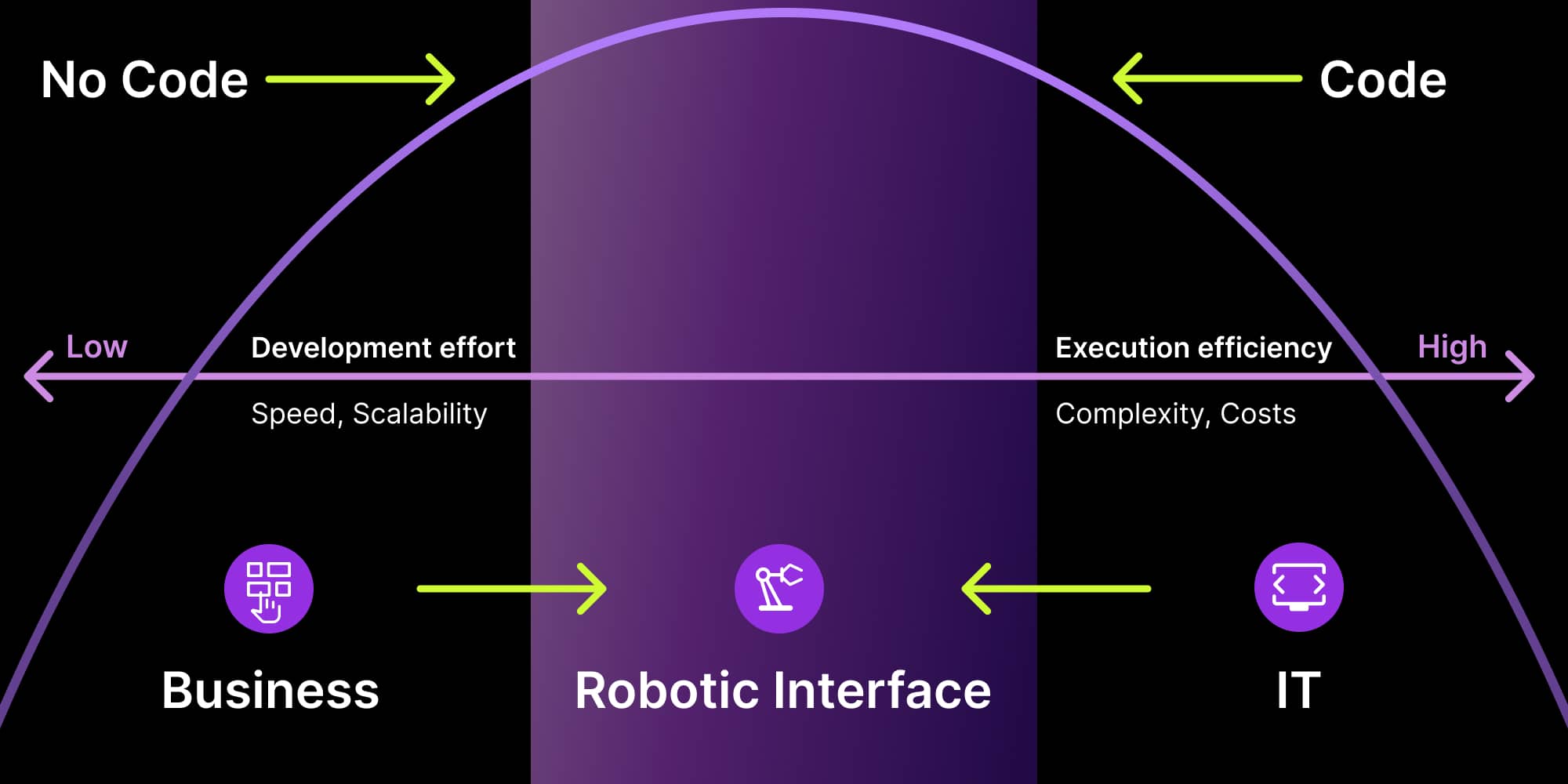
Looking back, these dynamics marked a period of rapid growth and early consolidation in the RPA market. They also paved the way for the next stage of evolution, where scale, platform maturity, and AI integration started to matter more.
Former leaders of Magic Quadrant for Robotic Process Automation

UiPath
The UiPath platform was one of the most widely recognized and sophisticated solutions on the market at the time. It was considered a leader in execution and deployment speed, supported by a large number of client success stories. The software included an integrated library of pre-built automation components that augmented custom automation efforts.
The company built a strong network of alliances with technology partners who supported clients during implementation. While not all deployment scenarios were low-code or no-code, UiPath clearly aimed to provide an intuitive user interface for its bot management dashboard.
Automation Anywhere
It was recognized as a market leader within the exclusively RPA-focused segment in the analyst reports published at the time. The platform was known for fast implementation and ready-to-use integrations, which made it attractive for organizations looking for quick automation wins. The company had a strong global market presence.
Most routine bot automations were designed to be easy to build, even for less technical teams. Its flexible architecture allowed for straightforward scaling, while simpler bots were typically created using low-code approaches.
Blue Prism
It was considered one of the most established RPA vendors on the market, having been founded in 2001 by a team of software automation experts. Over time, the company built a large library of complementary automation, analytics, and decision management applications. Its services were primarily targeted at large enterprise organizations with significant operational scale and resources.
The graphical user interface enabled less technical staff to create automations, while a drag-and-drop interface supported the design of process automation workflows.
Conclusions from the previous Forrester Wave report
The Forrester Wave™ report identified the 14 most significant RPA providers, similar to Gartner’s “Magic Quadrant for Robotic Process Automation, which featured 16 vendors of Robotic process automation software. The leaders were companies that had established the category back in the 20s. The podium included UIPath, Blue Prism, and Automation Everywhere. They delivered complex platform and professional services but differed when it product specification, graphical user interface, the level of Artificial Intelligence (AI), or Machine Learning (ML).
At the time, these differences were mainly discussed in terms of features, platform maturity, and technical capabilities. However, they also hinted at a broader shift in how RPA solutions would be evaluated in the years to come. As the market evolved, aspects such as usability, user friendly RPA, orchestration and the role of AI began to move closer to the center of attention – a shift that later analyst reports would clearly highlight.
Build automated workflows faster with a visual, user-friendly builder
Explore Workflow Builder SDK
What changed during the years? A quick comparison of Gartner RPA insights – 2020 vs. 2025
Looking back, several assumptions from the Gartner® Magic Quadrant™ for RPA 2020 proved accurate. The market did grow at a double-digit pace, and RPA became a permanent part of large organizations’ automation strategies. What changed was the focus – in 2020, growth was discussed mainly in terms of RPA as a standalone category, while in 2025 Gartner clearly emphasizes the rise of broader automation platforms rather than individual bots.
The role of COVID-19 and remote work was also correctly identified as a catalyst. However, what was expected to be a temporary acceleration became a turning point, after which organizations began to expect much more than simple task automation.
At the same time, some assumptions evolved. Artificial intelligence, underestimated in 2020, became a key evaluation criterion, reshaping how RPA solutions are designed and assessed. Friendly RPA user interface and usability – barely mentioned in earlier reports – now play an important role, directly influencing adoption beyond IT teams.
Market outlook and key takeaways from Gartner RPA 2025
- Gartner reports that the RPA market has generated $3.8 billion in revenue, growing 18% year over year. It’s significantly faster than the broader infrastructure software market (growth of 10.7%).
- The report predicts that by 2027, 60% of RPA vendors will introduce “computer use” capabilities to better support UI: reinforcing the importance of a user friendly RPA experiences.
- In 2025, UiPath and Automation Anywhere continued to lead the market, confirming that the RPA space is still dominated by a group of mature providers. Microsoft took third place as the leader, moving SS&C Blue Prism to fourth place in the ranking.
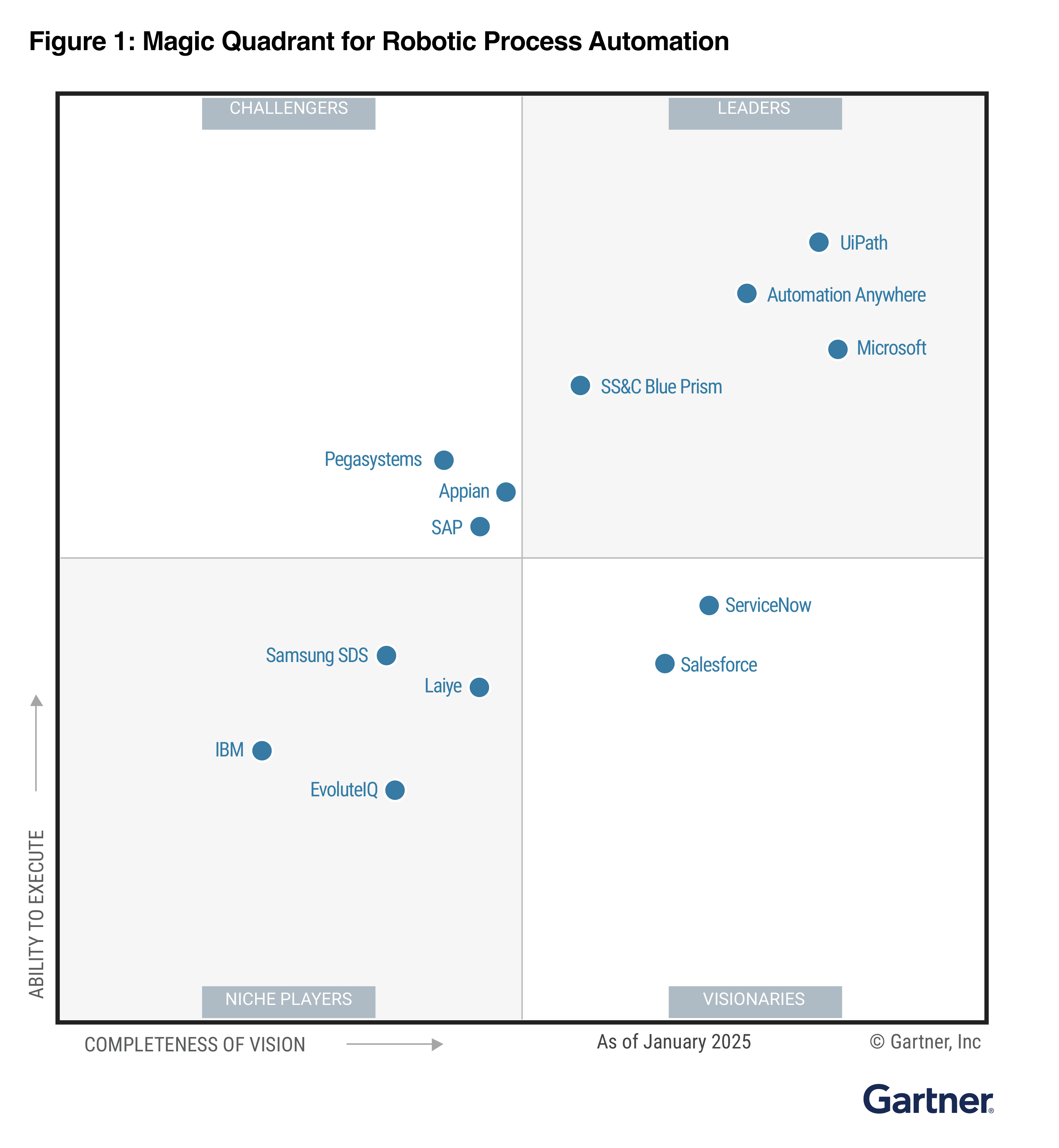
New leaders of Magic Quadrant for Robotic Process Automation
UiPath – Clear vision including RPA and BPA synergy
UiPath believes that the RPA category has become more critical than ever as people and agentic automation now work side by side on complex, cross-functional tasks. At the same time, the company sees RPA as a key enabler that allows AI agents to take action across business processes – unlocking RPA and BPA synergy through secure, structured access to data.
Gartner's report recognized UiPath for:
- A clear vision for the agentic future – The company empowers clients to build AI agents that make decisions, respond to changing conditions, and collaborate seamlessly with both people and systems to drive outcomes.
- Enterprise-grade execution – Successful automation at scale requires proven reliability in complex environments. UiPath supports global organizations with the expertise, scalability, and consistency needed to deliver.
UiPath attributes its position in the Gartner report to specific actions and platform capabilities, including:
- Investing in generative AI to enable automation through natural language prompts.
- Deploying self-healing robots that stay resilient as systems evolve.
- Expanding operating system and app coverage – including support for macOS automation.
- Acting as a committed partner focused on delivering ROI and driving transformation – not just providing tools.
Automation Anywhere – Seamless interface technology for process automation
Automation Anywhere also has been recognized as a Leader in this category for the seventh consecutive year. The company believes its continued presence in the report reflects a strong commitment to driving measurable productivity gains through innovative technologies and a customer-first approach.
- Evolving from task-based RPA to intelligent automation with AI and machine learning – and now advancing toward autonomous operations (APA) with AI-powered agents.
- Process Reasoning Engine (PRE) proprietary, industry-first intelligent AI engine, designed to strengthen and extend the Automation Anywhere platform.
Microsoft – A mature tech leader, new to the RPA market
Microsoft was recognized by Gartner not only in the RPA category but also across several other areas, reflecting the company’s maturity and broad technological leadership. Its mission – to empower every person and organization to achieve more – aligns with its role in driving digital transformation through the intelligent cloud and intelligent edge.
Although Microsoft entered the RPA space only in 2020 with Power Automate, a tool that helps users automate repetitive tasks using prebuilt bots, it already secured a strong third place in the Leaders Quadrant. This is especially noteworthy given the product’s relatively short time on the market.
Still, as Blue Prism notes, the RPA user interface needs improvement, and troubleshooting remains a challenge – with full end-to-end automation often requiring integration with other Microsoft tools.
The Forrester Wave™: Task-Centric Automation Software, Q4 2024
The key conclusion from The Forrester Wave™: Task-Centric Automation Software, Q4 2024 is that the RPA market has fundamentally changed. In 2024, traditional robotic process automation no longer reflects how organizations automate work. As a result, Forrester deliberately renamed the report, signaling a shift toward task-centric automation – solutions that bring AI, task coordination and human work together in a single platform.
Forrester makes it clear that automation leaders now win by orchestrating work across systems, embedding advanced AI and enabling teams to scale productivity. Pure task bots are no longer enough. The market is moving toward platforms that treat automation as a strategic capability, not a tactical cost saver.
In the report, Forrester identified and evaluated 15 significant vendors. Two of them stand out as leaders.
Forrester highlights ServiceNow for its clear strategic vision, AI-driven roadmap and deep integration across its application portfolio, reinforced by a powerful partner ecosystem.
The other leader, Pegasystems, received the highest scores possible in 18 of the 23 criteria. Forrester describes Pega as a powerhouse in task-centric automation, well suited for organizations that want automation to drive long-term transformation, innovation, and growth – not just short-term efficiency gains.

User friendly interface is becoming an unfair advantage
Over the past few years, analyst reports have consistently pointed in the same direction – the future of automation belongs to business users, not only IT teams. As Gartner predicted, a growing share of RPA adoption comes from non-IT buyers, which changes how automation platforms must be designed. This means that user interface in business process management is no longer a secondary concern.
By 2026, this shift is clearly visible. Low-code and no-code adoption continues to grow, but ease of deployment alone is no longer enough. Organizations now expect interface technology for process automation that keeps complex environments understandable and manageable, even as systems and workflows change. A well-designed RPA user interface helps connect bots with broader business process automation, making outcomes and dependencies visible to business users.
Benefits of visual interface for process automation
So, what are the benefits of using a visual interface for process automation? From our experience, the answer goes far beyond aesthetics.
A strong visual interface can:
- Improve adoption by making automation easier to understand for non-technical users.
- Speed up onboarding and change management by reducing the learning curve.
- Support faster decision-making by showing how tasks, bots, and processes are connected.
- Enable business users to manage and adapt automation without constant IT involvement.
Both Gartner and Forrester show that usability and clear visual interaction directly affect automation success. In 2026, organizations that treat the graphical user interface as a core part of their automation strategy gain a clear advantage in scaling automation.
The winners of the no-code era
User friendly RPA is no longer about simplifying buttons or dashboards. It is about designing interfaces that translate complex automation logic into clear, actionable visuals. Robotic process automation has a lot to gain from the graphical user interface. It can bring simplicity, improve business operations by eliminating unnecessary coding, add value, and increase profit margins. Alternatively, this level of simple UI often means sacrificing some level of upper-level functionality in bot capability. Companies that overcome these challenges become the winners of the no-code era.
- Is RPA still relevant in 2026, or is it being replaced by AI?
RPA remains relevant in 2026, but its role has clearly evolved. Analyst reports show that RPA is increasingly embedded in broader automation platforms, where it works alongside AI – enabling UI-based automation and process coordination rather than operating as standalone bots.
- Why does the RPA user interface matter more than it did a few years ago?
As RPA moves beyond isolated bots, the user interface becomes the main way users understand how automation supports real business processes. Gartner and Forrester reports show that usability now directly affects adoption and automation success.
- What are the benefits of using a visual interface for process automation?
The benefits of visual interface for process automation include faster onboarding, better collaboration between IT and business teams, and clearer insight into how tasks, AI agents and workflows are connected. Visual models also reduce errors and simplify management.
- How can my organization build better visual interfaces into RPA system?
Synergy Codes’ Workflow Builder helps teams design and manage processes through a clear, visual interface. It complements RPA tools by making workflows understandable for business users and supporting visualizations across systems, which aligns with modern automation trends highlighted in analyst reports.
Content Marketing Specialist who's spent the last decade making tech topics actually readable. With an MA in Brand Communication, Ida has crafted content strategies for several IT companies. Her portfolio spans from Kubernetes tutorials to enterprise software guides, now focusing on data visualization and diagramming solutions.

Find how we can help you enhance your software and win more deals
Contact us to discuss your project. After you submit the form, we’ll get in touch with you within 48 hours to arrange a call.