


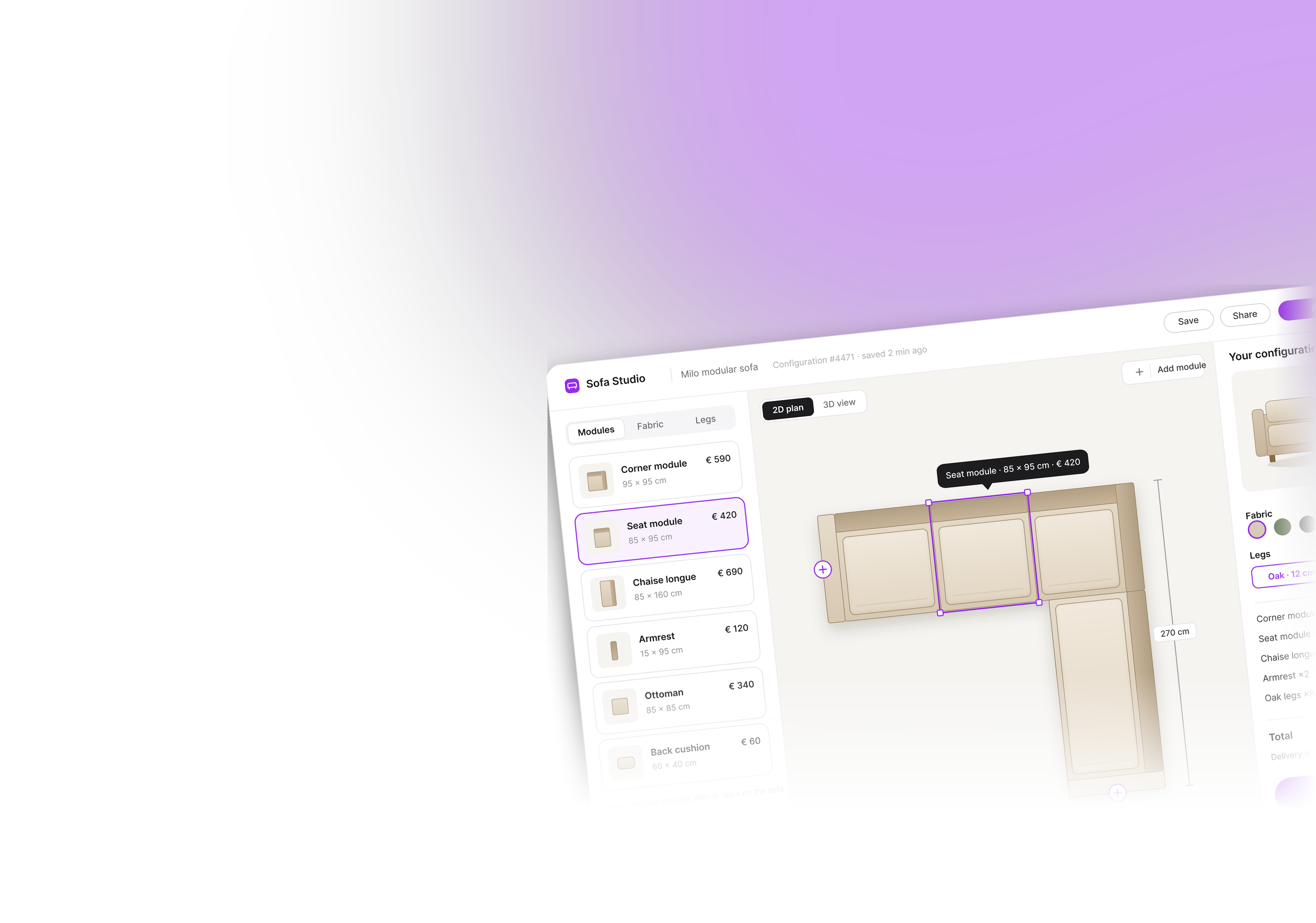
Selling configurable products shouldn't work like this
If customers order your products by drawing, email, or phone, you already know the problems that follow – and what they cost your team every week.
Sketches instead of orders
Customers know what they want – but not what to order. So they send a drawing, a photo, or a floor plan, and wait for your quote.
Every quote is manual labor
Someone on your team assembles each order item by item, from a catalog of hundreds or thousands of products.
Engineers do paperwork
A technical person reads each request, prepares the drawing and the price, and emails it back.
Dropdowns posing as a configurator
Option lists with no real rules – they don't check what can be manufactured, and they don't end in an order.
Wrong orders cost twice
Customers pick parts that don't fit together. The returns, rework, and refunds land on you.
Competitors already have one
In more and more niches, a configurator on the website is what customers expect before they order.
Every one of these is your team's time – and lost orders.
From your website to a finished order
All that back-and-forth can turn into steps your customers run themselves – they build the product on your site, the rules check it, and the order arrives ready to process.
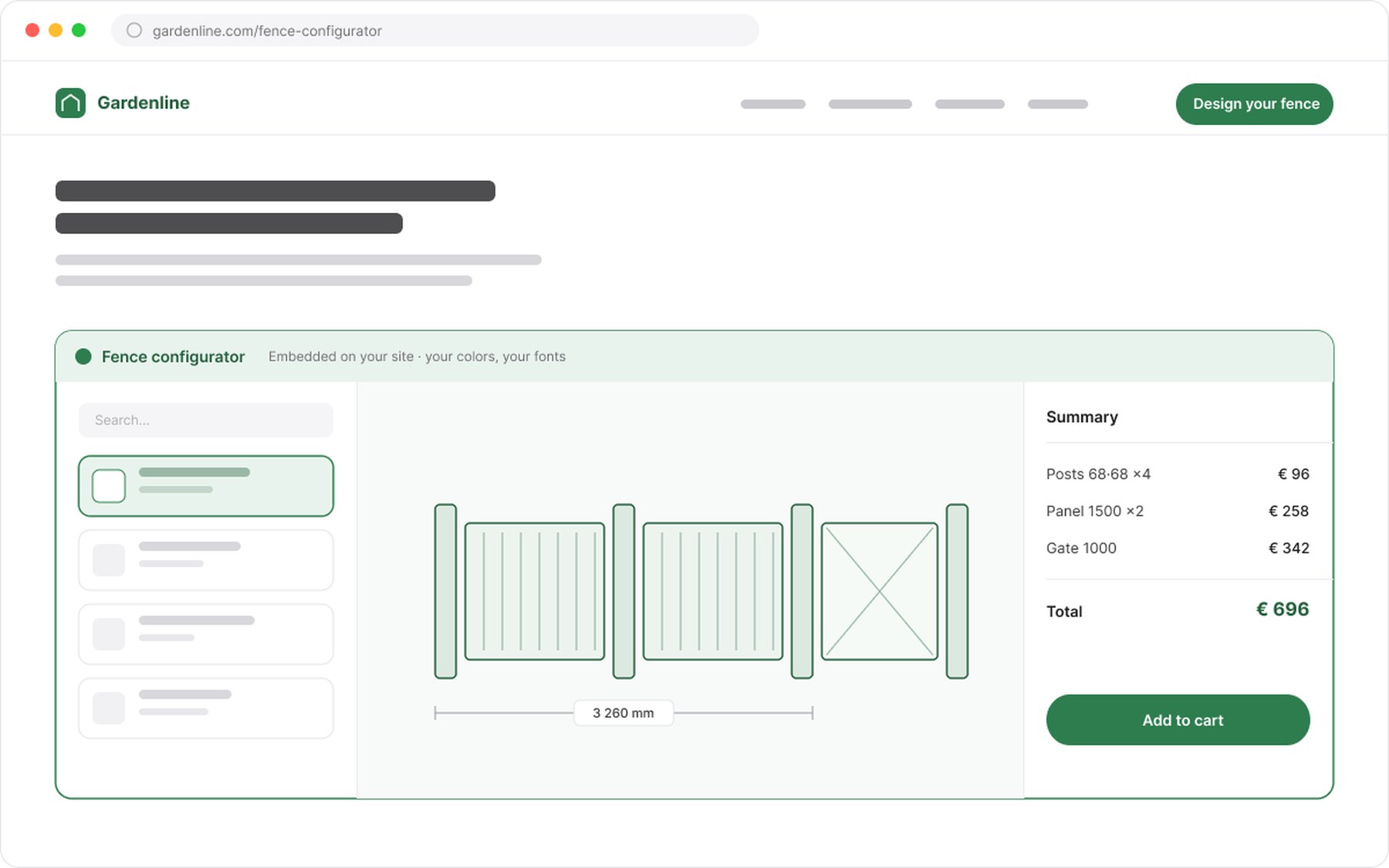
Your customers open the configurator on your site
The configurator is embedded in your website and matches your brand's look and feel. Buyers start from a product page, with no separate app and no login.
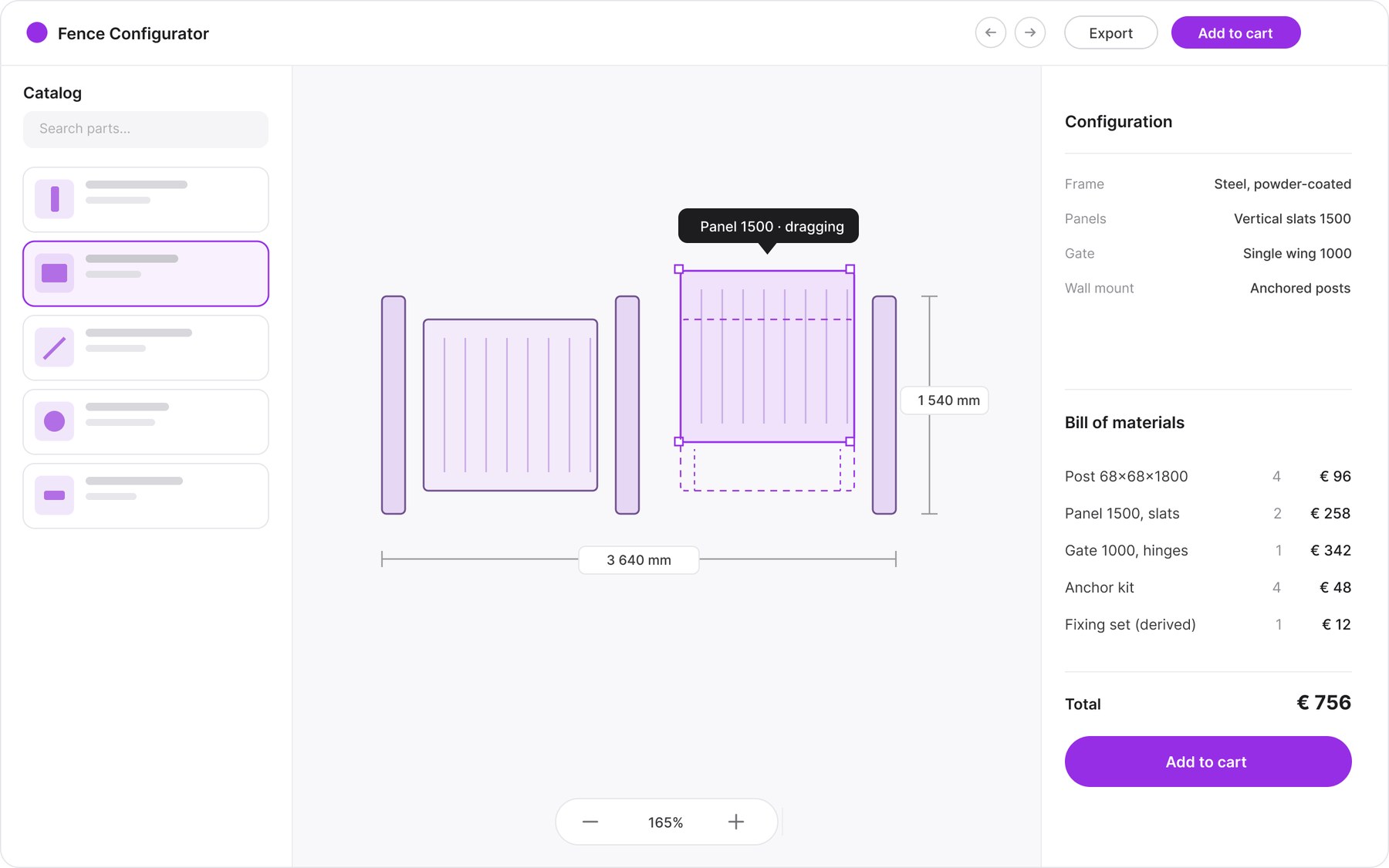
The product takes shape on the canvas
On a 2D canvas, buyers assemble it from parts, presets, or option lists, with dimensions in view.
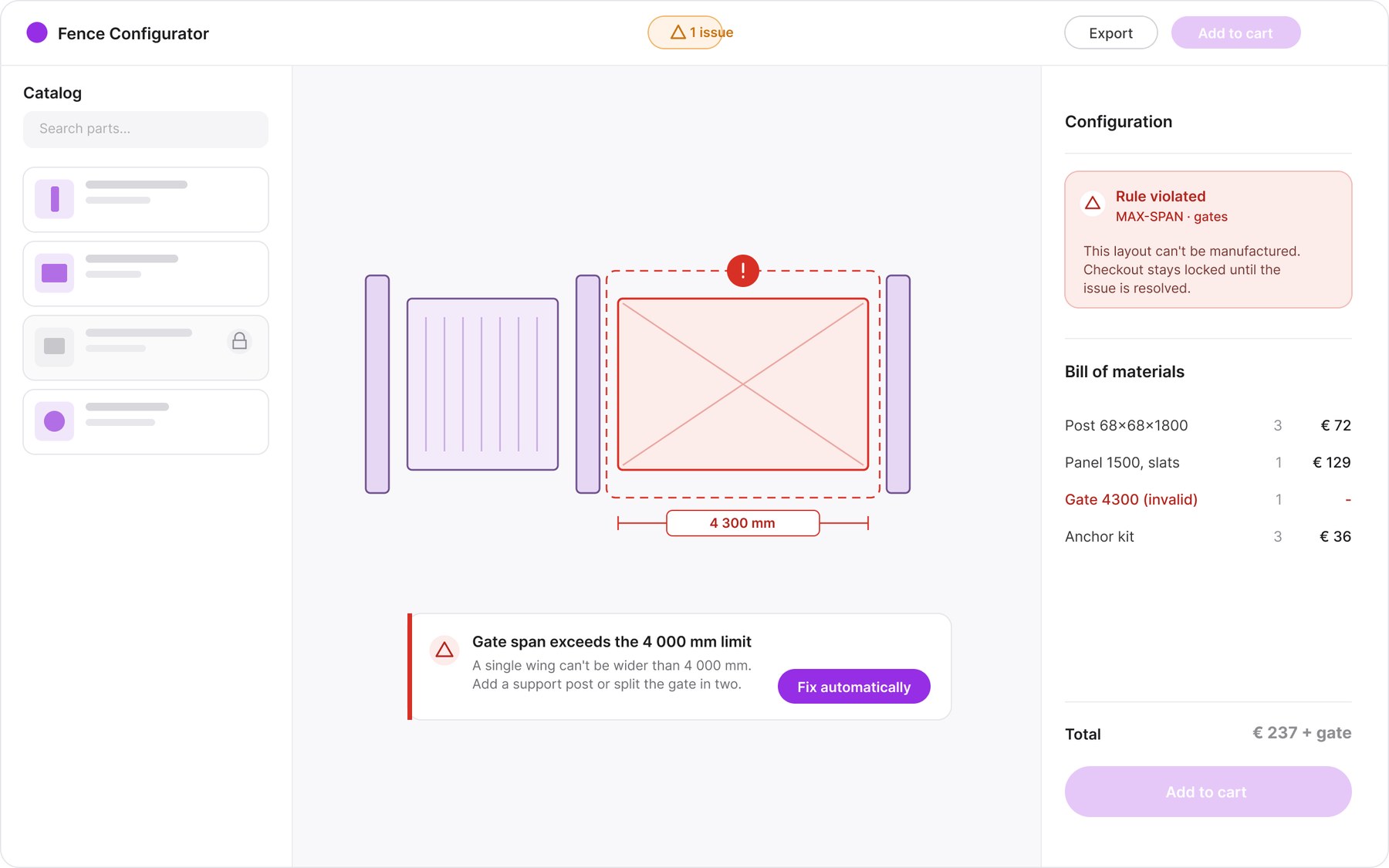
The rules do the checking
The price and the parts list update with every change, and the rules flag combinations that don't work.
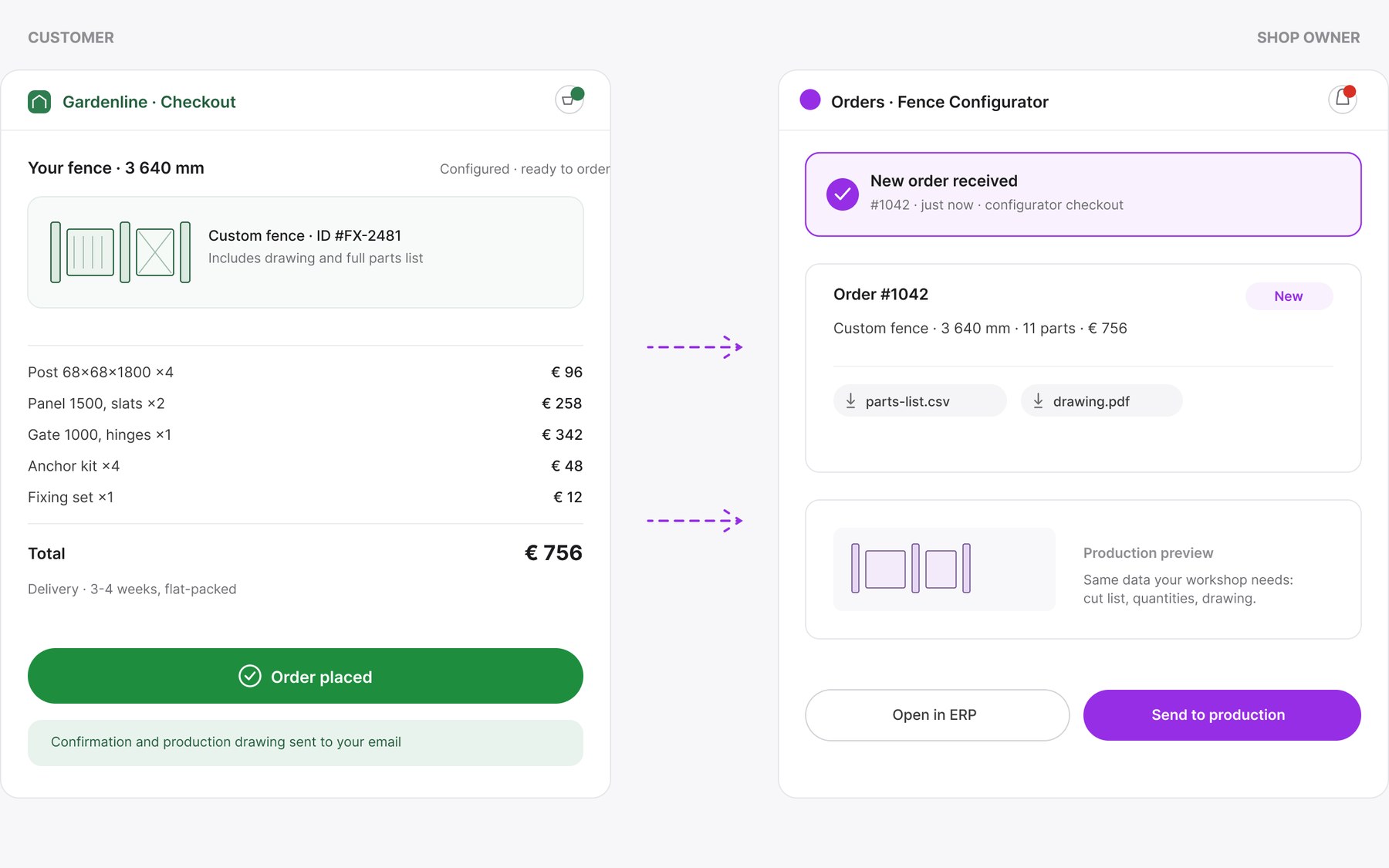
The result fits the way you sell
It becomes an order in the cart, a PDF quote with a dimensioned drawing, an inquiry in your inbox – or anything else, depending on your ordering flow.

Where ready-made product configurators usually stop
An off-the-shelf product configurator handles simple option lists. Products assembled from parts, with dimensions and compatibility rules, need a different engine.
Is your product a fit for a configurator?
A configurator for linear lighting on a ceiling plan. Freestanding and built-in furniture. Carts assembled from frames and accessories. The industry doesn't decide the fit – what matters is how a product is put together. A 2D product configurator works when your product matches the following traits.
Panels, segments, modules, accessories – the product is assembled, not picked.
Lengths, increments, maximum spans – the numbers decide what fits.
Some parts belong together, and others aren't compatible.
Materials, colors, mounting types – every component has options.
A parts list, a price, and a drawing – ready for checkout or a quote.
The 2D test: if your product can be drawn as a plan, a schematic, or a dimensioned view, a custom configurator can make configuring it easier for your customers.

Delivered end to end
One team designs, builds, integrates, and deploys the configurator in your store. You bring the product catalog and the rules – the delivery is ours.
How we work together
45 minutes – you see a working configurator, and we get to know your product and how you sell today.
We dig into your needs, order flow, customers, and technology, then come back with a timeline and a budget.
We build on our tested foundation and wire in your catalog, rules, and store.
Integrated with your store and your workflow – the code and documentation handed to you.
What you get
UI design in your brand.
Our designers build the configurator as a real part of your store, matched to your colors, fonts, and components.A product configurator engine
Compatibility, sizes, and variants checked in real time as the configuration is built.Bill of materials and drawings
Each finished configuration produces a parts list mapped to your catalog and a drawing for reference.
Your catalog, mapped
Products, parts, and presets your customers can open and adjust.Configurator integration
Your store, orders, and payments wired in – Shopify, WooCommerce, or any other platform.The code
Deployed on your site, documented, and owned by you.
Why manufacturers choose Synergy Codes for configurators
The team, the process, and the tested foundation come from 15 years of building visual software for engineering and production.
Built on proven foundations
Your project doesn't start from zero. We build your custom configurator on a foundation refined across many projects, so your budget goes into your catalog, your rules, and your integrations.
Experts in diagramming technology
We work with the leading diagramming technologies daily – and develop ngDiagram, an open-source diagramming library published under Apache 2.0.
Proven in production
200+ projects delivered in 15 years – including product configurators for manufacturers of lighting, equipment, and more.
FAQ
- What is a rule-based product configurator?
A rule-based product configurator checks every choice against your product logic as the buyer builds: dimensional rules such as lengths, increments, and spans; compatibility rules for what fits together; and variant rules for materials and mounting types. You decide what happens when a rule is broken – block the combination, or warn the buyer and let them continue.
- What is a 2D product configurator?
A 2D product configurator lets customers design a product on a flat, dimensioned view – a plan, a layout, or a schematic – instead of rotating a 3D model. For products assembled from parts, the 2D view is the one your production team actually uses: it carries exact dimensions, positions, and the full parts list.
- How is a custom product configurator different from a store plugin?
A plugin lets customers pick options from lists; a custom product configurator from Synergy Codes lets them assemble the product visually, with your rules checking every step. Plugins bend your product to their template. A custom build maps your catalog, your logic, and your brand.
- Can a custom product configurator be integrated with my online store?
Yes – the service is end to end. Synergy Codes builds the configurator, embeds it in your storefront, and wires it to your cart, checkout, and payments. Shopify and WooCommerce are the most common setups, and we integrate with other ecommerce platforms and custom stores too. A finished configuration becomes a standard order in your admin panel.
- What if I don't sell online – can the configurator generate quotes instead?
Yes. The configurator's output follows your process: a downloadable PDF quote with a dimensioned drawing, a sales inquiry sent to your inbox, or an order created in your system. Synergy Codes builds whichever ending you need – selling online is not a requirement for a custom configurator.
- How long does it take to build a custom product configurator?
Because the work builds on proven foundations instead of starting from zero, a custom product configurator is faster to deliver than a fully bespoke build. You receive a concrete scope and timeline after the discovery phase, before any build starts.
- Who owns the code of a custom-built product configurator?
You do. A configurator built by Synergy Codes comes with full code ownership and a handover. You pay no subscription just for existing, and no monthly fee to keep what you paid for. Your team extends it later, or ours does, whichever you prefer.
- What does Synergy Codes need from me to start?
It starts with a discovery phase – a short set of workshops where we map your products, your rules, your order flow, and how your customers will use the configurator. You bring the product catalog and your rules in whatever form they exist today; we turn them into a specification, then design, build, integrate, and deploy.
Ready to stop quoting by hand?
Tell us what you make and how you take orders today – we will get back to you within 24 hours.

Not a fan of contact forms?
Reach out to Maciej on LinkedIn
Maciej Teska
CEO at Synergy Codes