


Where current tooling can't meet electrical teams' standards.

- Tools don’t communicate, keeping data fragmented
- Any change triggers manual updates across 5+ systems
- Circuit symbols are inconsistent across engineering tools
- Errors compound with each change

Routing fights your geometry – overlapping lines mean manual cleanup before every export
- Symbols snap to grid – not to the connection points where they should land
- Every revision is a redraw – auto-generation rarely works for electrical
- Cognitive overload at 1,000 nodes – engineers scroll instead of design

- Building from scratch takes a year before your team ships anything
- Off-the-shelf tools force engineers to work around them, not with them
- Build-vs-buy decisions stall electrical projects for months
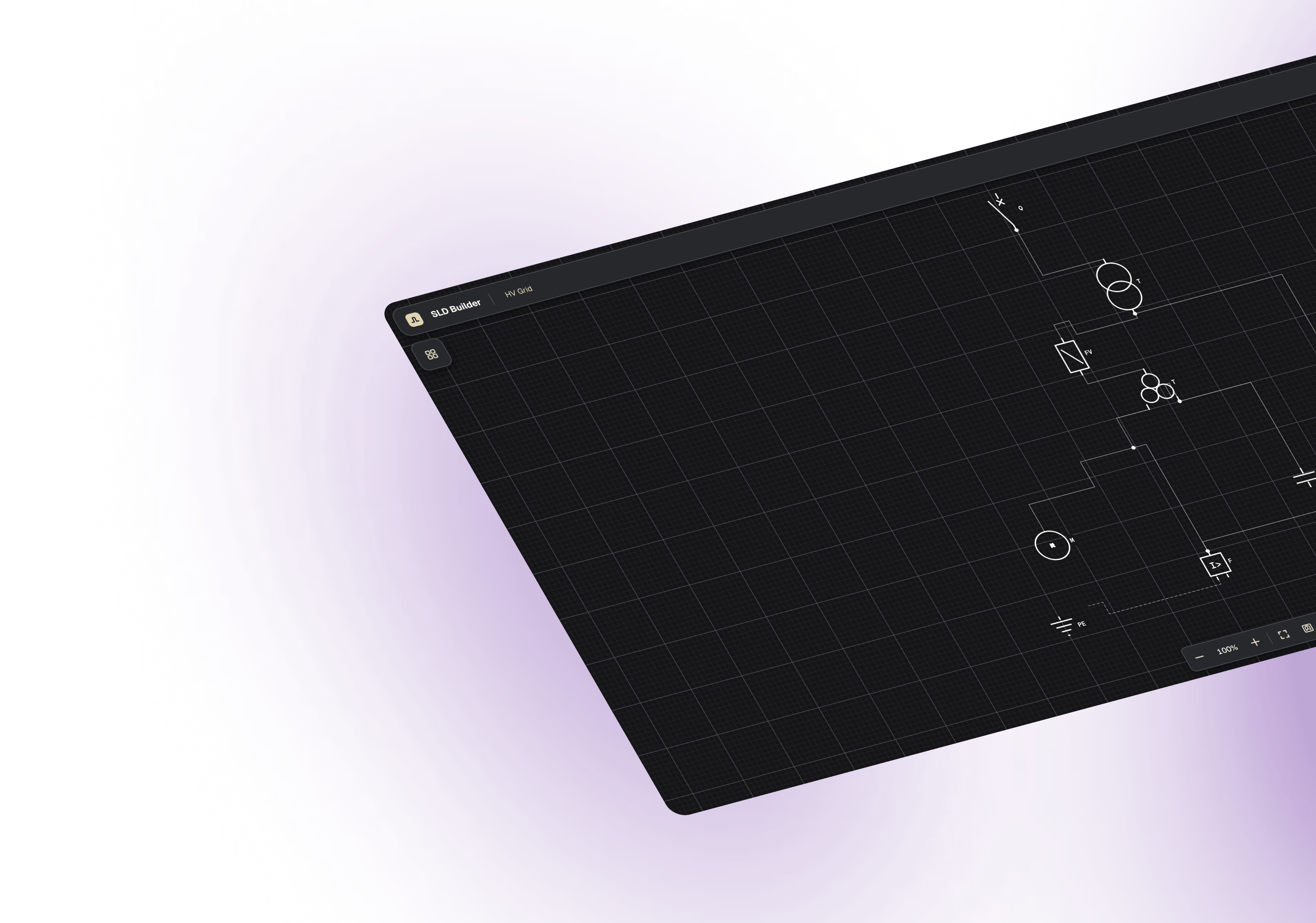
Experience electrical Single Line Diagram your project can start from
Skip the demo call. Drop a symbol. Route a wire. Change a property. Export to DXF. Decide afterwards.
Electrical software that adapts
to your team, not the other way around
Each capability solves a friction your team hits today. Pick what you need for your use case. None of it starts from a blank file.
- Proven auto-layout algorithms handling 3,000+ components
- Clear, error-free connections with custom routing logic that maintains straight connections
- Dynamic regeneration when specifications change - no manual rework needed
- Integrated simulation engines for real-time or batch analysis
- Digital twin creation – virtual replicas for live monitoring and predictive maintenance
- What-if scenarios – test design changes instantly, reduce risk and cost
- High-performing incident detection from sensor to screen in seconds
- Live data binding with SCADA, IoT, and industrial databases
- Custom dashboards showing only the metrics operators need
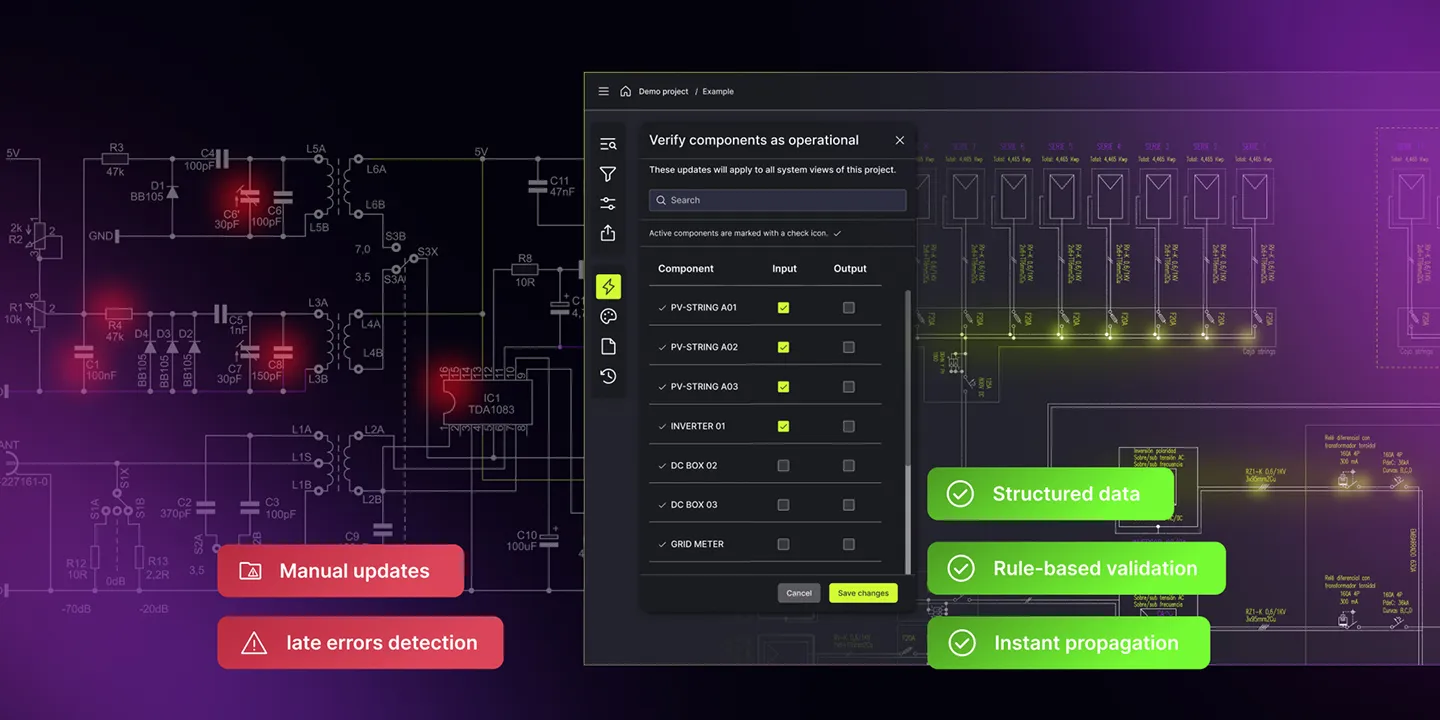
- Rule-based validation preventing impossible electrical connections
- Industry notation compliance (IEC, IEEE, ANSI) built into the interface
- Real-time feedback – errors flagged instantly as your engineers work
infrastructure – no rip-and-replace required.
- Integrations with AutoCAD, EPLAN, Simulink, SCADA, ERP, and custom APIs
- Web-based, cloud or on-premise deployment
- Performance-tuned for your largest projects and data volumes
- Concurrent editing with conflict resolution
- Component-level version control and full change history
- Touch device support for field engineers and commissioning
- Smart routing that anticipates your next connection
- Magnetic snapping so symbols land where they belong
- No overlapping lines, no manual cleanup before export
The features above cover most electrical software needs. What sits outside this list gets mapped during discovery – what your team requires, what your integrations demand, what your standards enforce.
The electrical documentation checklist
Your team already doesn't trust the drawings.
Outdated schematics quietly burn 30% of your project time. Score your electrical documentation in 10 minutes.
25 questions
5 areas of electrical documentation health, scored individually
so you see the exact gap.
5 areas, one clear gap
Find which structural weakness costs you the most – and what fixes it first.
10-minute self-assessment
No call, no demo. Just your team's current state, mapped against patterns from 200+ diagram tools.

Examples of custom electrical solutions we have delivered
↳ Case study
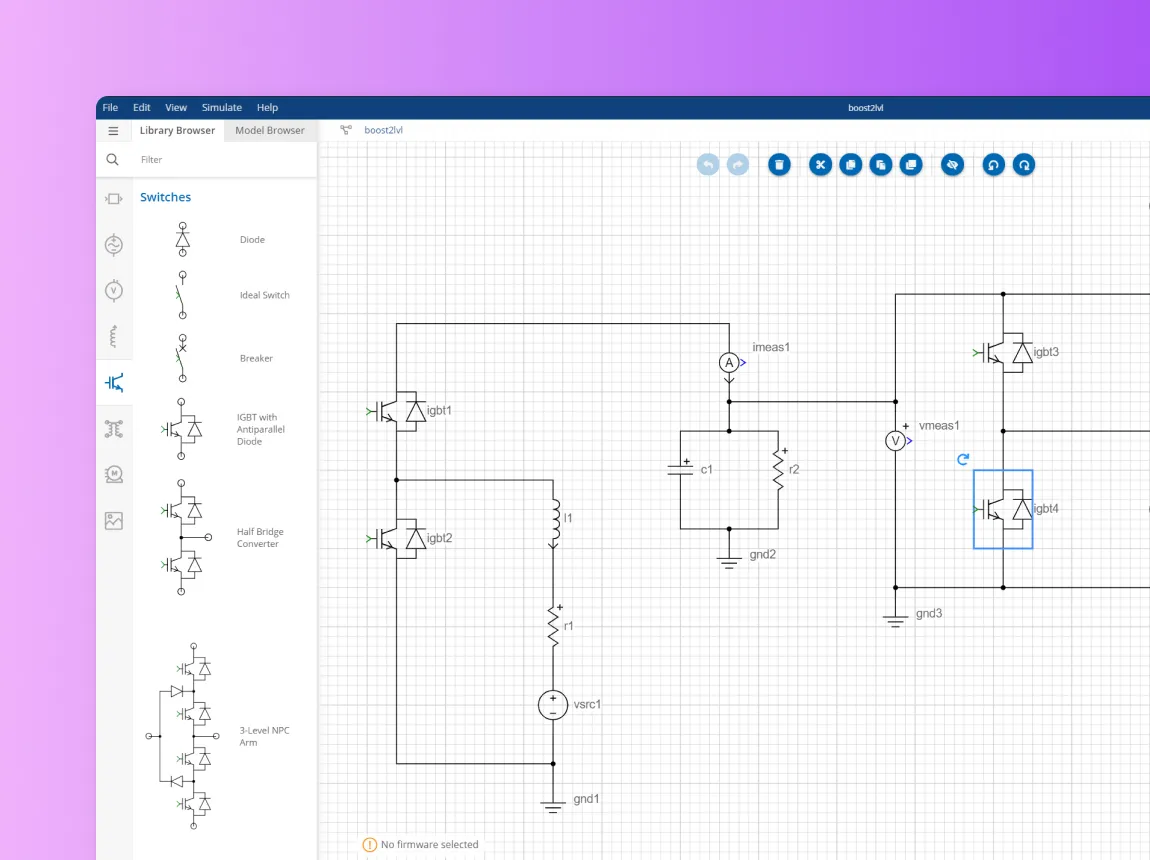
Schematic editor for electronics circuits modeling
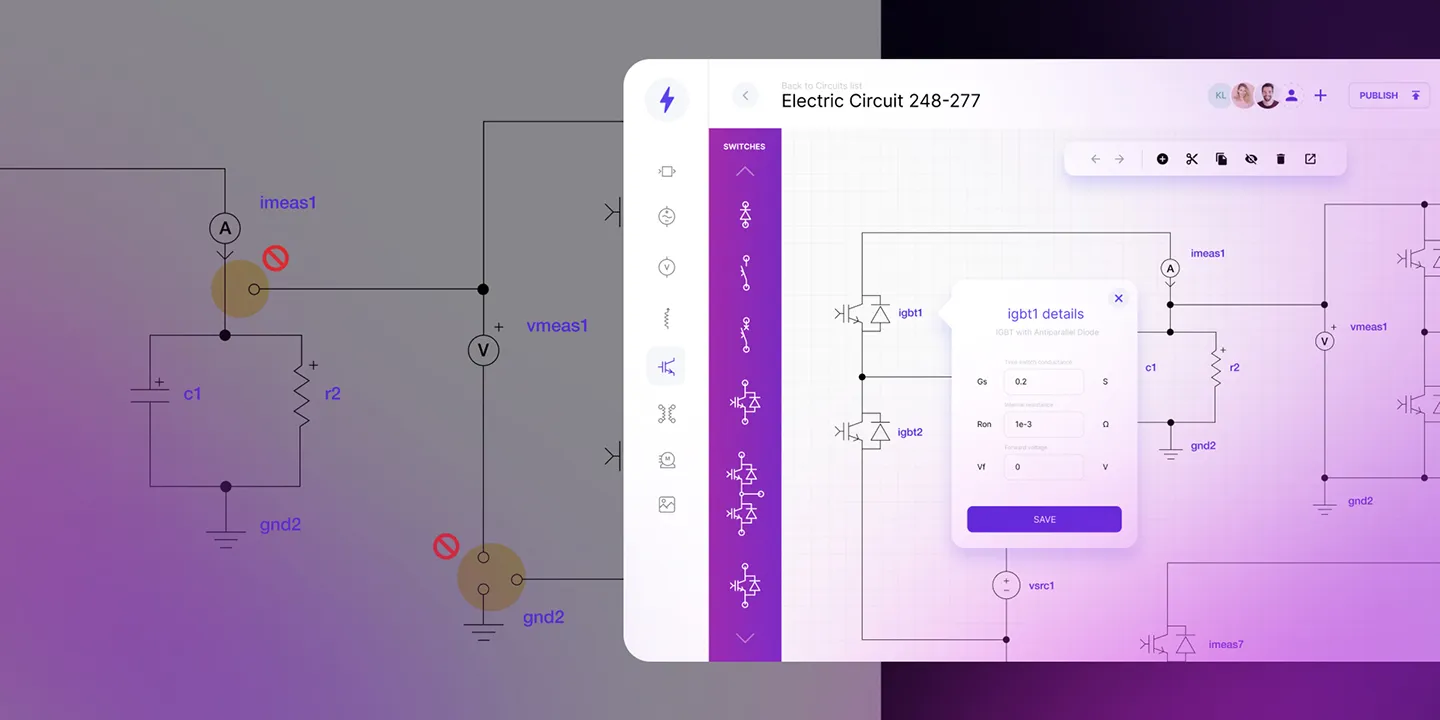
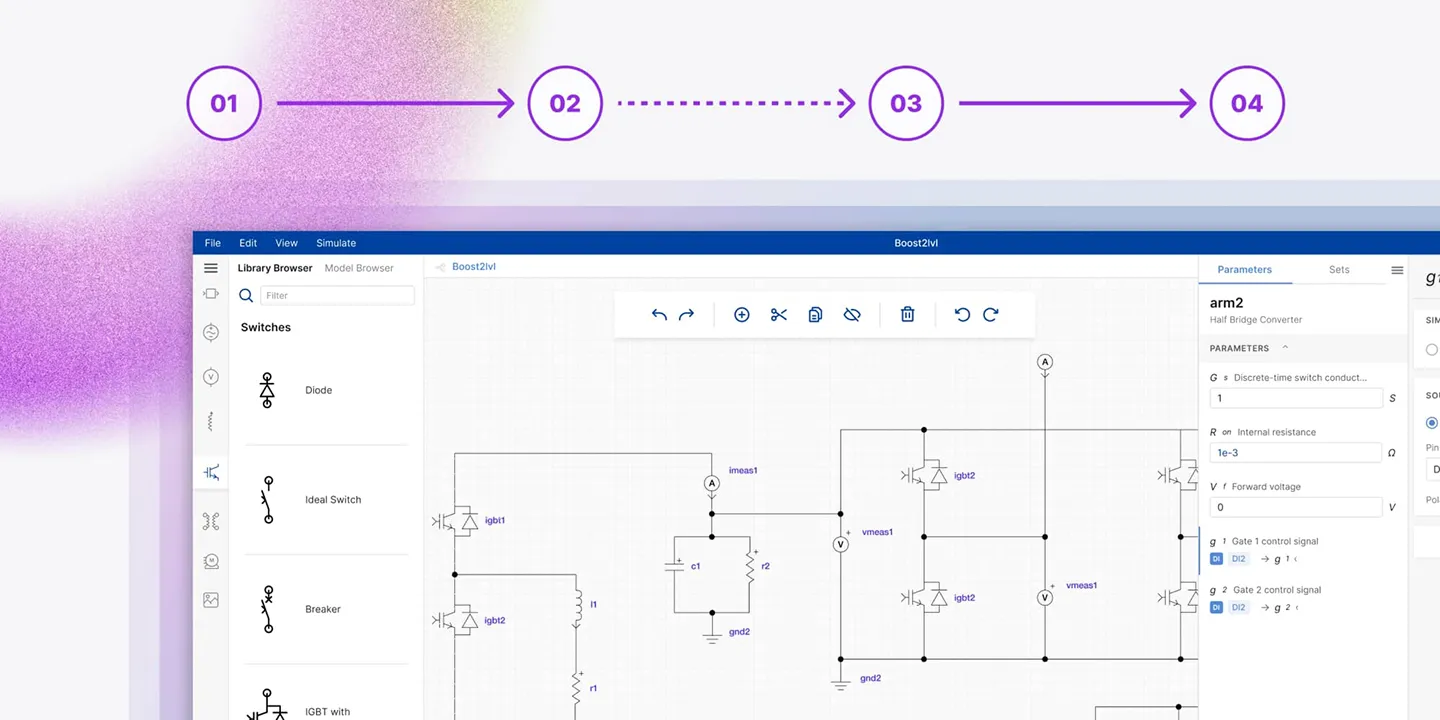
See how a power electronics testing company replaced costly market tools with a custom drag-and-drop editor. Engineers now create, validate, and reuse electrical diagrams with real-time signal propagation, streamlining the modeling process and ensuring accurate simulations through intuitive visual interface.
↳ Case study
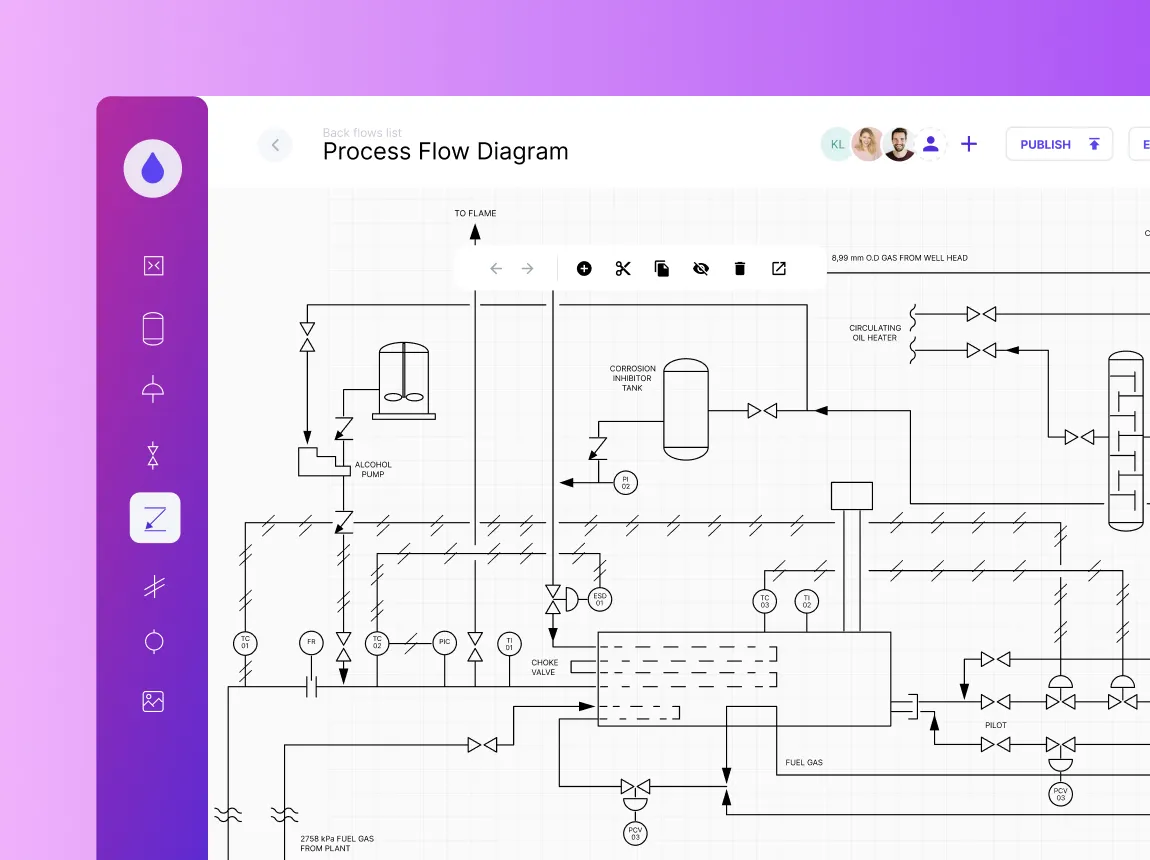
Custom P&ID software for real-time process insight
Discover how custom piping & instrumentation diagram software empowered a global energy leader to boost efficiency and make smarter decisions – thanks to real-time insights, intuitive diagrams, and instant alerts that revolutionized process control and team collaboration.
Got an electrical project in mind?
Let's scope it together – 30 minutes, no obligation.
Related resources
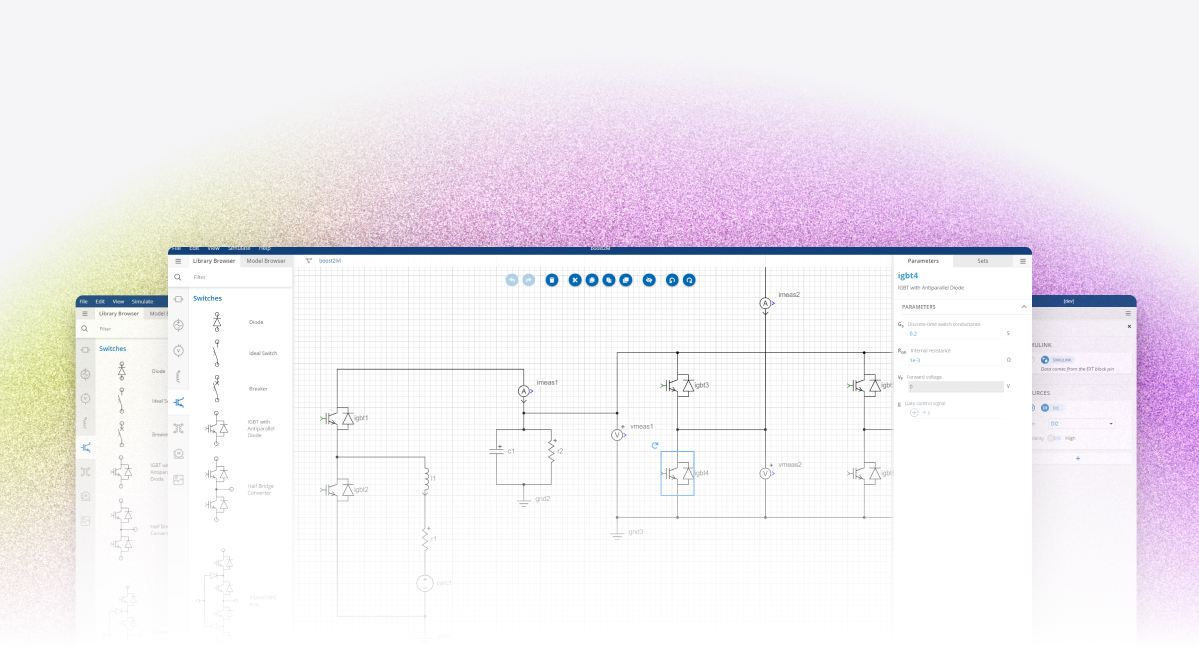
Score your electrical drawings in 5 areas. Find where outdated schematics cost your team time, accuracy, and control...
Take the checklist →

Control logic visualization turns static electrical drawings into dynamic systems...
Read article →
Learn how to manage documentation changes in industrial control systems (ICS)...
Read article →
Standard electrical CAD handles drawings, but not the workflow around them...
Read article →

Electrical schematics follow standards and repeat across projects. Learn why they are ideal for automation ...
Read article →

Compliance fails not because engineers lack knowledge, but because electrical design software...
Read article →
Off-the-shelf electrical design software stops scaling when workflows become complex...
Read article →
From concept to production in weeks
01
Discovery and PoC
Choose your starting point: design phase or jump straight to technical proof of concept.
- 2-hour discovery workshop to analyze workflows.
- UX/UI design and design system.
- Working PoC with your real data.
- Performance benchmarks for your largest systems.
- Clear roadmap and cost estimate.
02
Production-ready
Build a production-ready solution leveraging our diagram components for faster delivery.
- Full-stack development (frontend + backend).
- Automated drawing generation for primary use case.
- Custom component libraries and integrations.
- Deployment, training, and documentation.
03
Ongoing enhancement
Expand and optimize based on field usage and operational requirements.
- Additional drawing types and workflows.
- Advanced collaboration and automation features.
- Deep system integrations (ERP, CRM, APIs).
- Continuous support and optimization.
What's included in every project
- Custom development on top
of the SLD foundation– complete frontend and backend solution.
- UX/UI design and design system
– intuitive interfaces built for your workflow.
- Database architecture
– scalable data storage and management.
- Cloud hosting and infrastructure
– secure deployment and DevOps setup.
- API development and integrations
– connect with your existing systems.
- Complete source code ownership
– all IP rights transferred to you.
- Training and documentation
– ensure successful team adoption.
- Maintenance options
– ongoing support or full independence.
Reasons electrical teams ship with us
Enterprise teams keep choosing Synergy Codes for custom solutions over off-the-shelf products or in-house development for a reason. We went through electrical design challenges. We’ve built for it.

Your electrical schematics are not generic – your software shouldn’t be either. Every solution we deliver is built from the ground up for your unique processes, data, logic, and ambitions.

Building in-house sounds tempting – until you hit the wall of diagram logic, compliance with electrical standards, and scalable performance. We’ve seen teams lose months (and momentum) trying to reinvent what we’ve already solved.

Clunky interfaces that fight your workflows. "Modern" updates that break muscle memory. Your engineers deserve tools that amplify their expertise, not obstacle courses that waste it.

where others set their limits
where others set their limits
Anyone can try to force massive, complex diagrams into off-the-shelf tools, and end up with lags or crashes. Custom algorithms and architecture make the electrical system bulletproof – handling tens of thousands of components with real-time updates.

No off-the-shelf product will ever give you your own business logic, your preferred technology, or the performance you need for advanced projects. We embed your rules, your standards, and your integrations from day one.

200+ diagram implementations taught us every dead end, so you avoid them. We know the shortcuts, the pitfalls, and have the right engineering building blocks that get you to value – fast.
FAQ
- Can I try the Single Line Diagram tool before booking a call?
Yes — the Single Line Diagram demo runs in your browser, no signup or email required. Drop symbols, route wires with smart routing, edit properties. The demo is the same SLD foundation we extend into custom electrical software for production teams. Run through it, then decide if you want to talk.
- What is the Single Line Diagram template, and how does it fit into custom electrical software?
The Single Line Diagram template is the working foundation behind custom electrical projects we ship. Instead of starting your project from a blank file, your team starts from a proven SLD layer. Custom development happens on top: your standards, your workflow, your integrations. The demo on this page is the same template — run it in your browser to see how it behaves.
- How long does it take to build electrical design software?
Project timelines depend on scope and complexity. Proof-of-concept (PoC) can often be delivered in 2–4 weeks. A minimum viable product (MVP) typically takes 2–3 months. Full-featured, enterprise-grade solutions may require several months, but our modular approach allows you to see value quickly and expand over time.
- How does your platform handle large-scale electrical layouts?
Through virtualization, diagram partitioning, optimized algorithms, and flexible rendering engines for handling thousands of components in real time.
- What can custom electrical software do that off-the-shelf can't?
Off-the-shelf tools force you to adapt your process to their limitations. We adapt our solution to your process – delivering better performance, UX, and compliance.
- How customizable is the UI in custom electrical software?
Fully – every layer. Layout, features, symbol libraries, validation rules, and integrations all get built around your team's workflow. The starting template isn't a constraint – it's the proof that the diagramming layer already works. Everything visible to your engineers gets shaped around how they work.
- Is custom electrical software an alternative to EPLAN, ETAP, or AutoCAD Electrical?
Yes — but not a like-for-like replacement. EPLAN, ETAP, and AutoCAD Electrical solve specific parts of the engineering stack: schematics, simulation, CAD drafting. Custom electrical software bridges the gaps they leave — workflows specific to your team's standards, data flowing between disconnected tools, validation rules unique to your products. Most teams keep their existing stack and add custom software where the gaps are biggest.
- Does custom electrical software replace EPLAN, AutoCAD Electrical, or KiCad?
Not always. Our solutions can complement or extend your existing CAD tools by automating specific workflows, integrating your data, or providing advanced validation and collaboration features. In some cases, we can fully replace CAD for certain processes – especially when automation and integration are key.
- Can we automate electrical drawing standards?
Yes. We embed your company’s standards and industry regulations directly into the software. This means all diagrams are automatically validated for compliance, and errors are flagged in real time – ensuring consistency and reducing costly mistakes.
- Do you support real-time data for electrical schematics?
Yes. Our solutions can connect to live data sources (e.g., SCADA, IoT, industrial databases) and visualize operational status directly on your diagrams. This enables real-time monitoring, incident detection, and digital twin scenarios for your electrical systems.
Ready to map your project? Let's talk about your electrical software needs.
Share your use case. We'll get back within 24 hours.

Not a fan of contact forms?
Reach out to Maciej on LinkedIn
Maciej Teska
CEO at Synergy Codes