

Circuit concepting still lives in tools built for a different decade
Engineers start with an idea and end with a board. The step in between - picking real components and wiring them into a first schematic - still runs on desktop apps from 2005, PDF datasheets, screenshots, and spreadsheet BOMs.
Concepting happens outside your ecosystem
Engineers select parts in generic tools and spreadsheets. By the time your catalog enters the picture, the socket may already belong to whoever made selection easiest.
Desktop tools from a different decade
No browser, no share-link, no real-time collaboration. And generic diagram tools do not understand pins, junctions, or component topology - so your team rebuilds it badly on the side.
The canvas is the part AI coding won't hand you
AI coding will scaffold most of your app fast. It will not hand you a correct circuit canvas. Pin-aware wiring, wire-to-wire junctions, orthogonal routing, and the topology edge cases are precision work: they have to be right, because a wrong connection on a real board is a wrong board. React Flow and GoJS draw boxes and lines, but they do not understand pins, nets, or junctions, so your team rebuilds topology by hand. That is the layer codegen stalls on, and the layer we have already built and tested.
We know this market, and where we fit in it
Circuit design is moving to the browser, and it is moving fast. The semiconductor market is on track from roughly $600B today toward $1T by 2030, and a wave of tools is modernizing how engineers concept and select parts:
Automates schematic generation from requirements - design reuse and block-level assembly.
AI that generates production-ready schematics and selects components automatically.
Browser-native PCB design with AI assistance and real-time collaboration.
Generates circuits from code - design-as-software for electronics.
They all ship one finished product to engineers, and they are good at it. We take a different path: we build the tool around you - your component catalog, your rules, your brand, your customers - on a canvas engine already running in production. When the category standardizes on the browser, the only question left is whose canvas sits under your workflow: someone else's, or yours.
See the canvas your project can start from
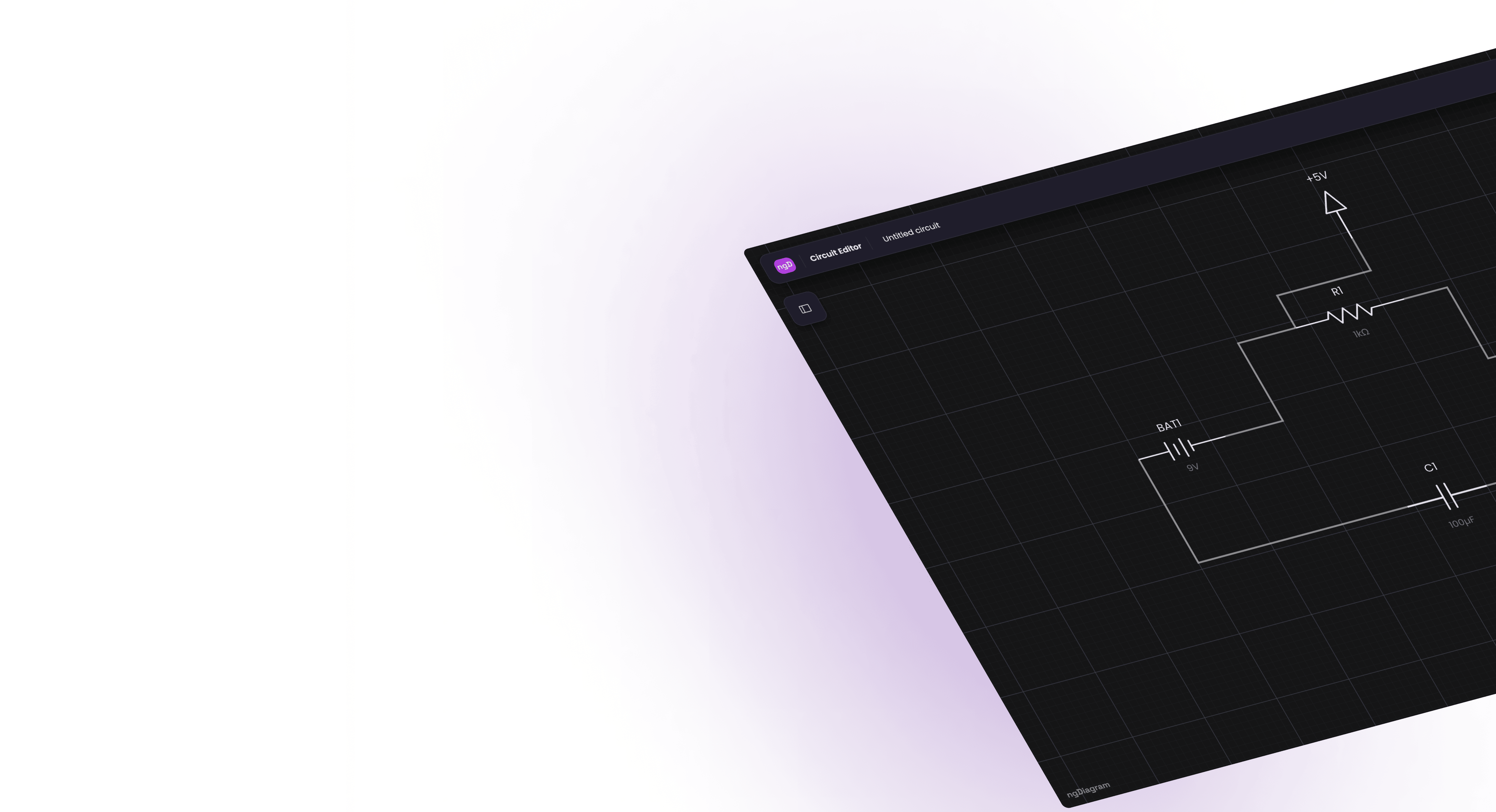
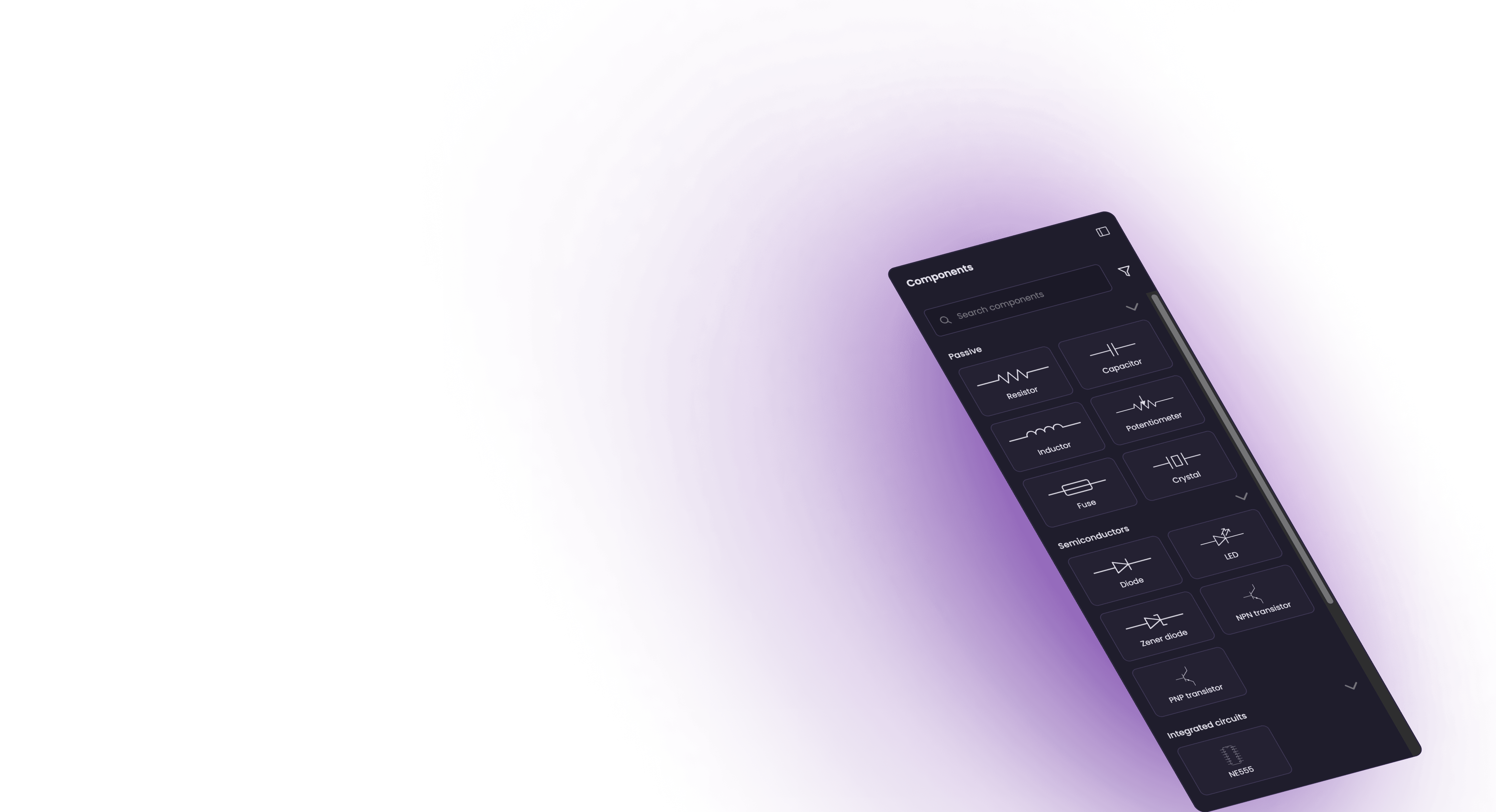
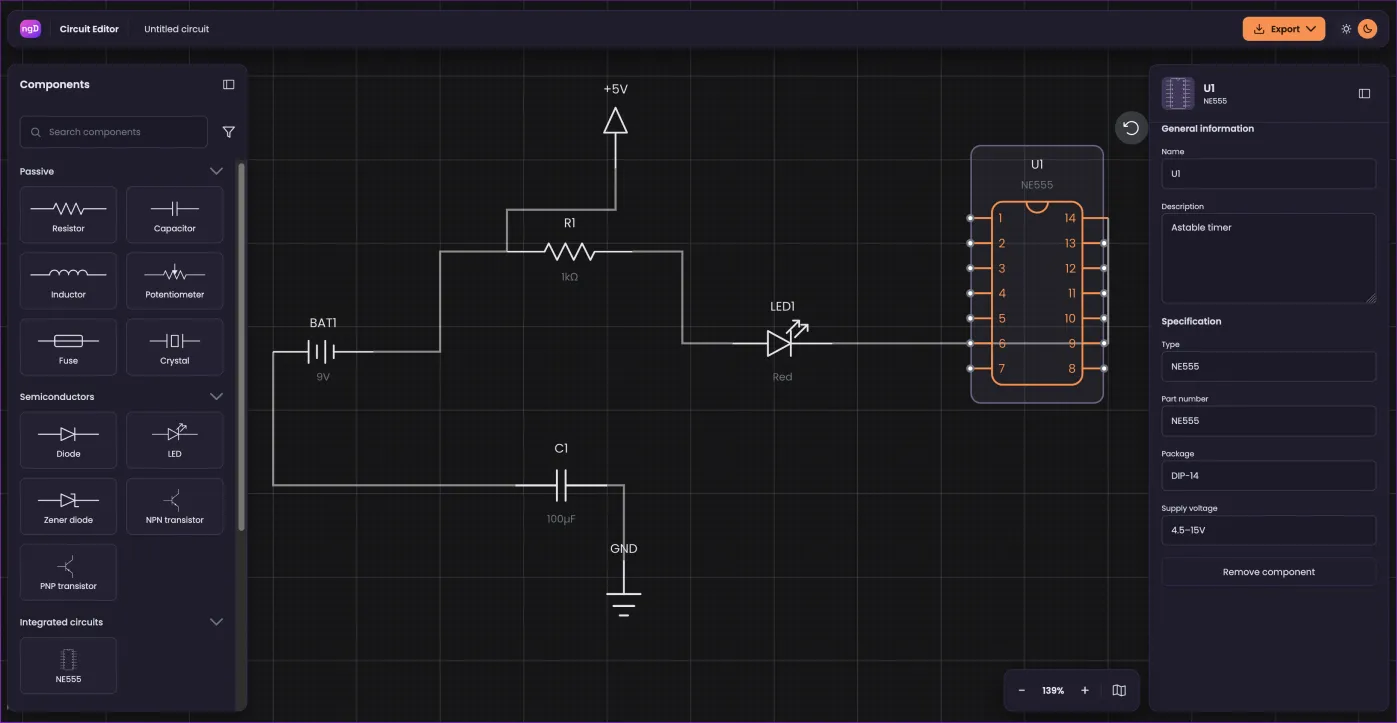
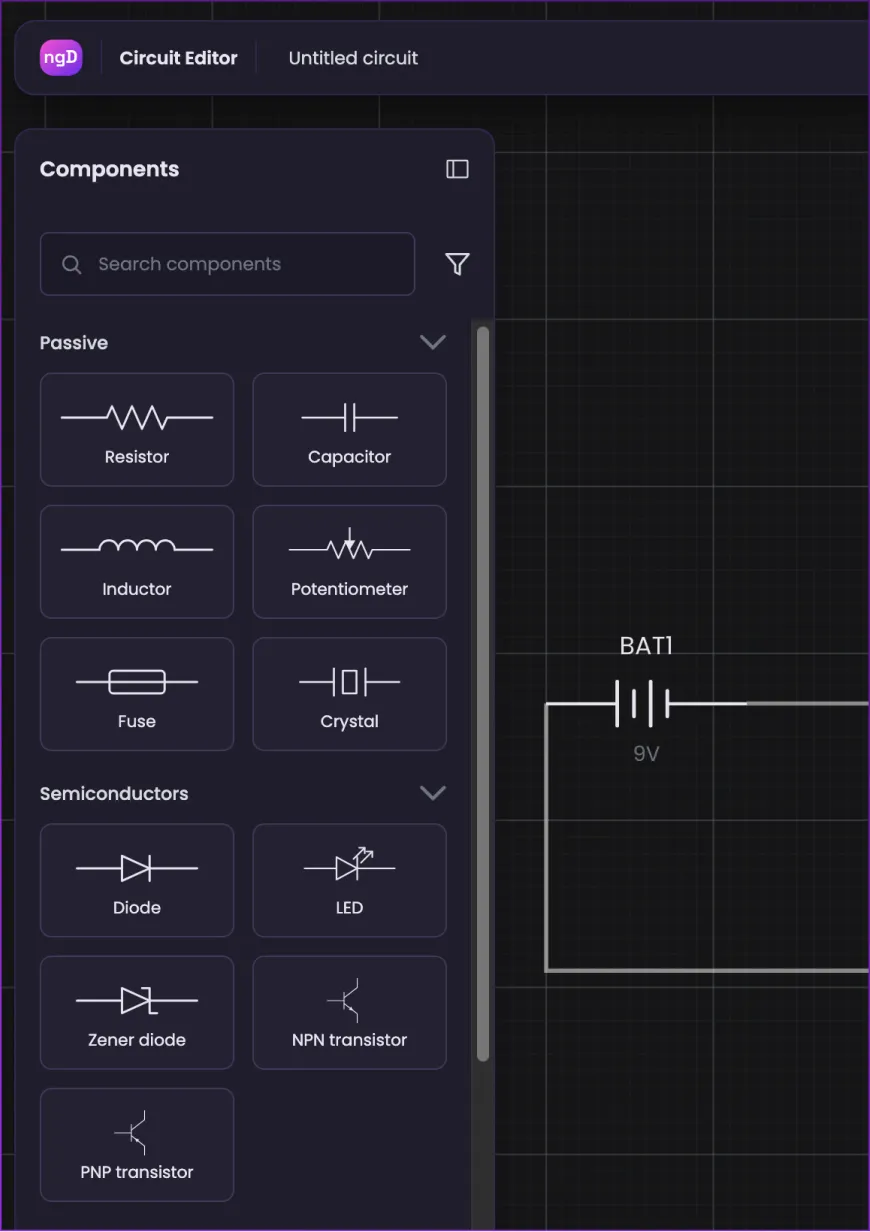
This is the actual open-source template, running in your browser. Drop components, wire pins, configure properties, export. No login, no sales call first.
Two starting points. One canvas underneath.
The big manufacturers built interactive design tools that pull part selection toward their own catalog, the kind most vendors cannot fund from scratch. We turn the canvas into that tool for you: branded, wired to your catalog, at mid-market cost, and yours to own.
Connects to your commercial stack: your catalog (PIM or product API), lead capture to your CRM, and a finished design that turns into a sample request or a quote.
Outcome: own the design-in moment - every concept built on your parts becomes a tracked lead and a BOM already priced from your catalog.
You design ICs or boards, or you run an in-house tooling team, and off-the-shelf tools do not fit - for performance, security, deployment, or integration with the products you already ship. We extend the template into a tool shaped around your workflow: your component model, your validation rules, your export targets.
On your terms: self-hostable, your security model, your integrations. You own 100% of the source we build - not just the open base.
Outcome: the browser tool your engineers want, with the hardest 6-9 months of build already behind you.
Working capabilities on day one
A functioning canvas you fork, theme, and extend.
We are the missing first step - concepting and component selection. We do not simulate voltages, validate electrical correctness, or generate footprints. That stays in your EDA - Altium, KiCad, OrCAD - and we hand off cleanly to it.
Open source, Apache 2.0
Open code you can run tonight.
The canvas is open source under Apache 2.0. That is deliberate, and it changes what you are agreeing to when you work with us.
It is real, and it runs
The hardest engineering is done, public, and verified against dense
multi-hundred-node schematics. Clone it and stress-test it yourself.
You own it. No lock-in.
Full source, yours outright. No per-seat fees, no subscription, no vendor raising the price on you next year. Self-hostable on your own security model. The canvas base stays Apache 2.0, and your custom work is yours.
Already building your own? Take the hard part.
You could build on the canvas alone, it is open source. Most teams come to us for the 20 percent that eats 80 percent of the timeline: wire-to-wire junctions, orthogonal routing, and the topology edge cases. Fork it, or let us tailor it to your components faster than you would reach a working prototype solo.
We have built circuit and schematic tools in production
For a component vendor
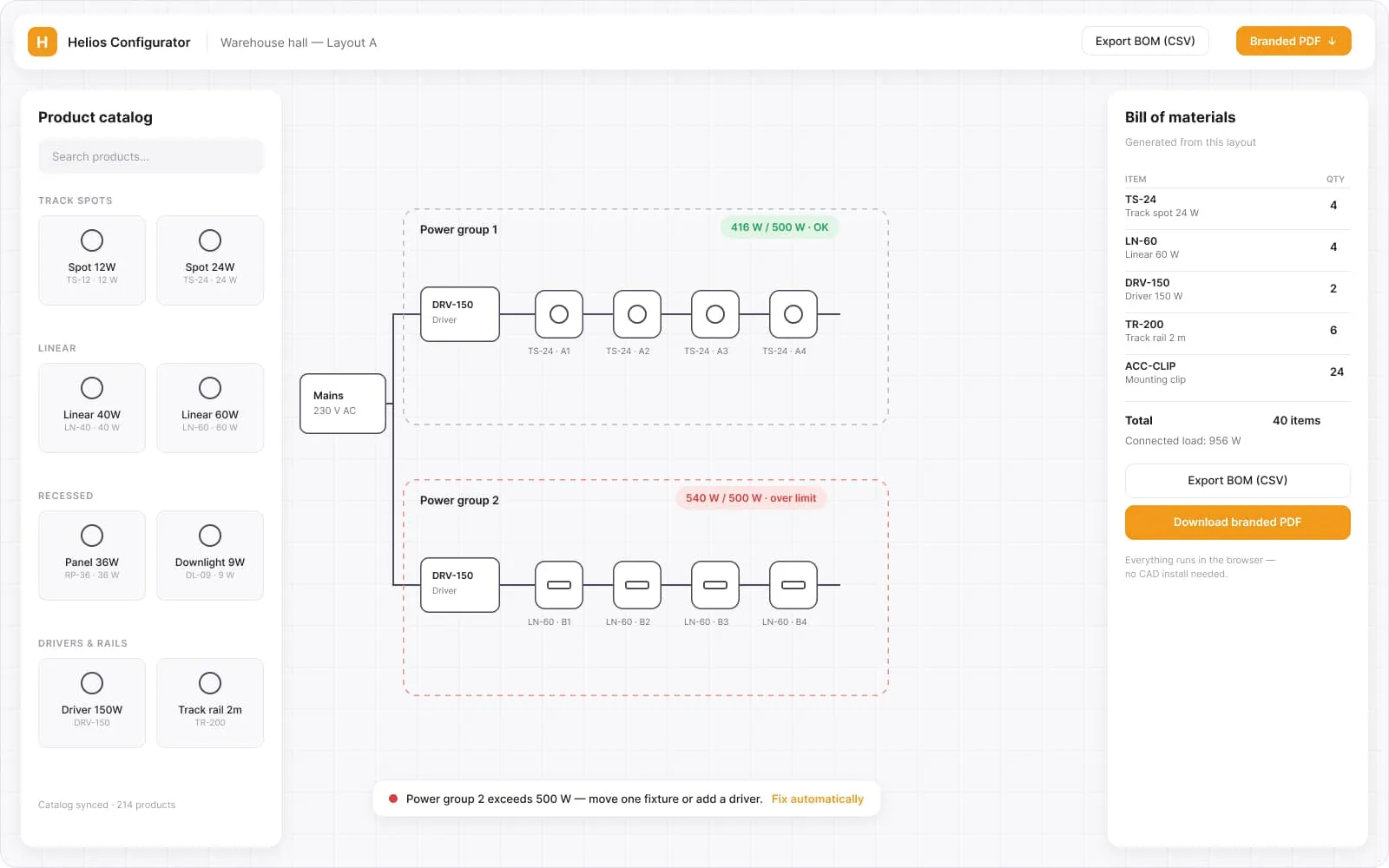
A lighting fixture manufacturer's branded configurator
Customers design fixture layouts from the manufacturer's own product catalog, wire them with valid power-group rules enforced automatically, and export a ready-to-order BOM and branded PDF - entirely in the browser.
For a hardware team
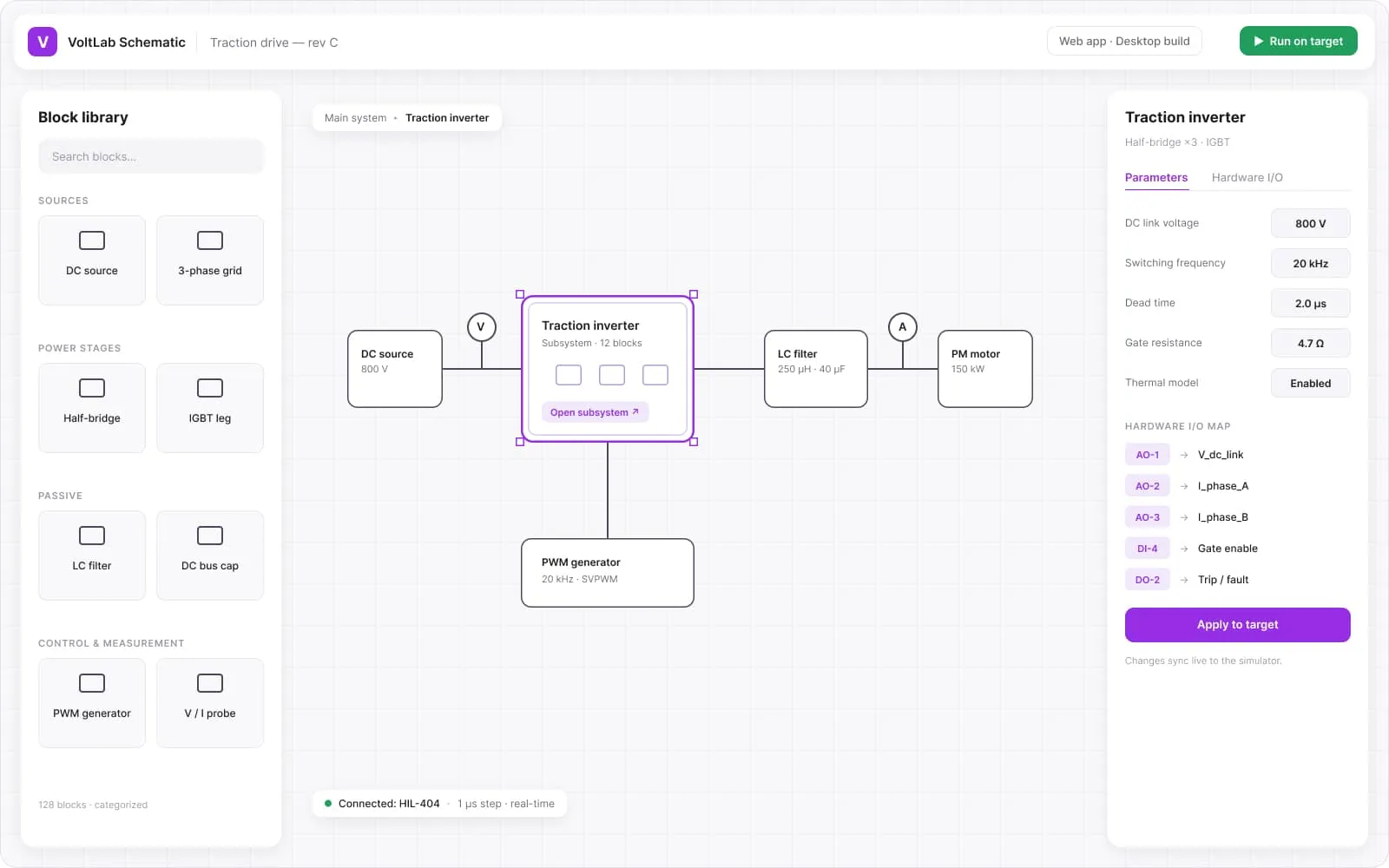
Power-electronics schematic editor (real-time simulation vendor)
A full-stack circuit-diagram editor with a categorized block library, hierarchical subsystems, parameter configuration, and hardware-I/O mapping - shipped as both a web app and a desktop build, integrated with the client's real-time simulation platform.
For a hardware team
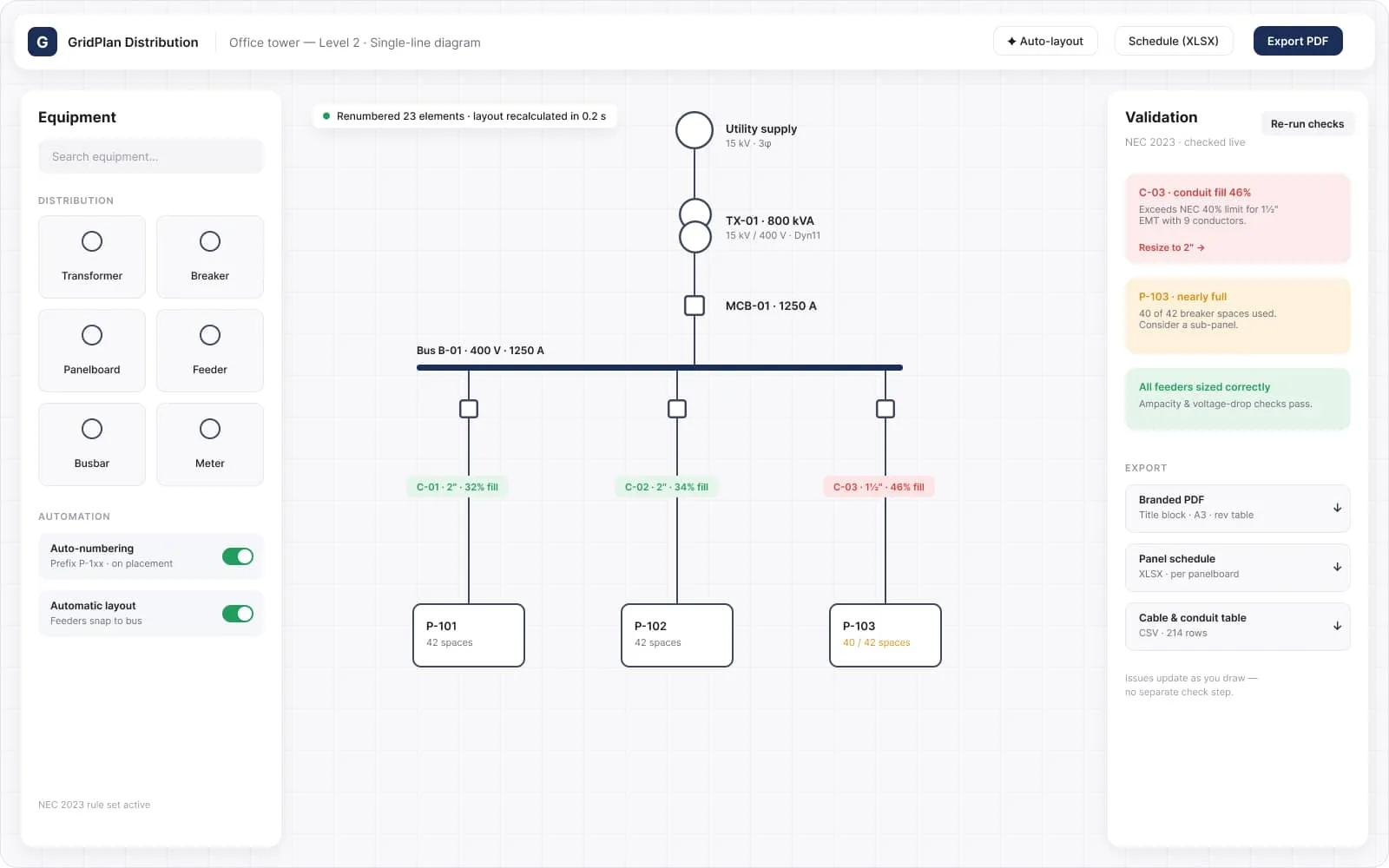
Power-distribution design platform (infrastructure engineering firm)
Interactive single-line diagrams with automatic layout, a rule-based engine that validates conduit sizing against electrical code (NEC fill limits), auto-numbering, and branded PDF and table export.
The engine underneath
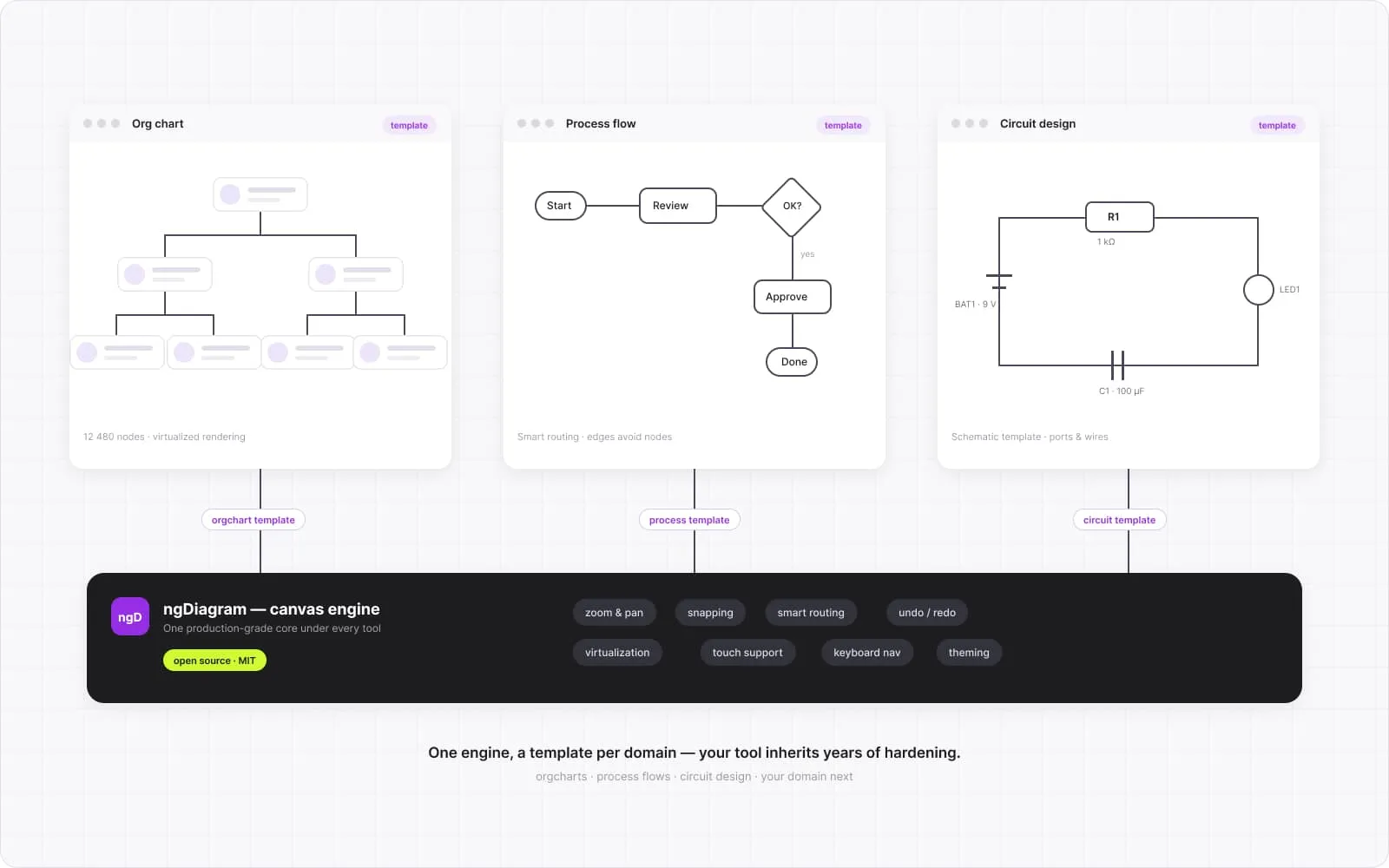
ngDiagram - our canvas engine
The same production-grade engine powers orgcharts, process flows, and now circuit design. One engine, a template per domain - so your tool inherits years of hardening.
From concept to a working tool in weeks
Your components, your users, your constraints - performance, security, integration, deployment.
We map your workflow onto the canvas and stress-test scale against your real complexity. You see your version's shape before development.
We extend the template, so the hardest first months are already behind you. Fixed-scope, not open-ended T&M.
Full source ownership, self-hostable, documented. Ongoing support and maintenance if you want it.
Included in every project: full source code · your branding · component-catalog integration · export targets you choose · CI and deploy setup.
Start from a working canvas, not a blank one
See the demo, then tell us what your version needs to do.
FAQ
- Is this a product I buy, or custom development?
Custom development on a working foundation. The template is the head start; your tool is built around your components and constraints, and you own it.
- Who owns the code, and under what license?
You own 100% of what we build for you. The canvas base stays Apache 2.0; your custom work is yours outright, with no per-seat fees and no vendor lock-in.
- What does an engagement cost and how long does it take?
Engagements are fixed-scope after a paid discovery workshop, so you are not signing an open-ended T&M contract. Most first versions ship in weeks; we size cost and timeline against your scope on the scoping call.
- Will it scale to a real, dense schematic?
The canvas is built for hundreds of nodes and nets with stable routing. We stress-test against your real complexity during the discovery workshop, before you commit to a build.
- Do you build the EDA, simulation, or footprints too?
No, and that is intentional. We cover concepting and component selection, then export cleanly to Altium, KiCad, OrCAD, or your pipeline. Simulation and layout stay in your EDA.
- Can we just fork the open-source template ourselves?
Yes. Apache 2.0 - fork, modify, ship. Teams engage us to skip the canvas plumbing, handle the hard topology edge-cases, and tailor it to their catalog faster than building solo.
- How is this different from Celus, Flux.ai, Circuit Mind, or JITX?
Those are finished products built for electronic engineers: Celus and Circuit Mind automate schematic generation, Flux.ai brings AI and collaboration to PCB design, JITX generates circuits from code. They are built to be one product for everyone. We build a tool that is yours - your component catalog, your rules, your brand, your customers - on a production canvas engine. For a component vendor that distinction is the whole point: none of them turn your parts into the design surface your customers start on. Yours can.
- Is AI part of this?
The canvas itself is deterministic and predictable, so your engineers stay in control. Where it earns its place, we add AI assists - part suggestions, error checks, autocompletion - as a layer for clients who want them. We do not hand your design to a black box.
- We sell components - how does this help us sell?
We turn the canvas into a branded configurator wired to your catalog, so customers concept with your parts, capture as leads in your CRM, and leave with a BOM that is already yours.
Ready to map your project?
Let's talk solutions.
Fill out the form, and we will get back to you within 24 hours to discuss the next steps.

Not a fan of contact forms?
Reach out to Maciej on LinkedIn
Maciej Teska
CEO at Synergy Codes