What does the process of creating a custom AV design automation platform look like?

From discovery workshops to a production-ready platform, here’s how a custom AV design automation tool is planned, designed, and built.
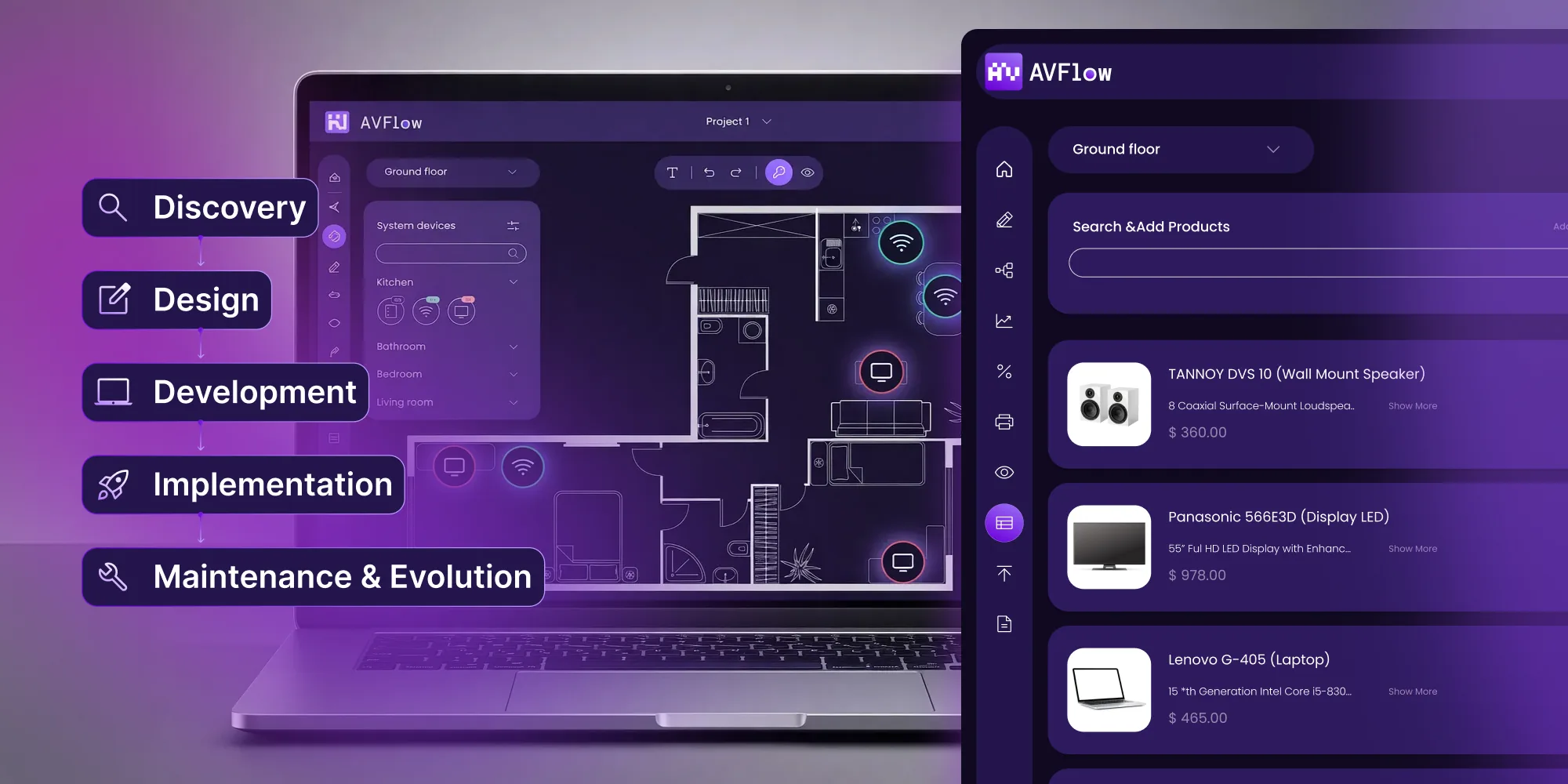
Building a custom AV design automation platform follows a structured process – from discovery workshops that map existing workflows, through interface design and Agile development, to launch, training, and ongoing support. The entire journey typically takes 3–6 months, resulting in a platform tailored to how AV teams design systems, generate proposals, and manage projects.
At some point, existing tools, diagram workflows, or proposal processes start limiting project speed, consistency, or scalability. That's where the interest in a custom AV design platform piques.
You're probably asking the same questions most teams do. What does the process involve, how long does it take, and what level of commitment does it require?
This article walks through the full journey, from early discovery workshops to a production-ready platform and further development, so you know what to expect at each stage.
See how custom AV software supports faster project delivery
Explore offer.png)
Step 1: Discovery – learning how your AV team works
Before committing to a custom AV platform, teams want clarity that the system will reflect how projects are already designed, quoted, and revised.
Every AV design software project at Synergy Codes starts with discovery, which is where these questions are addressed. At this stage, we examine how your teams plan projects, prepare diagrams, create proposals, and manage revisions across installations before any interface concepts or system architecture are introduced.
How discovery workshops are structured
Workshops and working sessions bring together both teams, including engineers, AV design consultants, and project stakeholders responsible for day-to-day workflows.
The process is structured so that decisions, deliverables, and responsibilities remain clear even for those without prior experience in software development projects.
The goal is to identify where handoffs slow down, where information gets duplicated, and how existing tools and processes create bottlenecks. Mapping these patterns comes before any platform decisions.
The duration depends on project scope and system complexity. Some discovery phases run for several days, others continue for multiple weeks.
Understanding workflows and dependencies
The discovery phase applies Design Thinking methods commonly used in product design and software planning. Sessions focus on understanding how your teams work, what they need, and which constraints the platform must respect. This may include discussions about existing tools, responsibilities, prior research, or any usability observations already available within your organization.
We capture insights using collaborative boards, recorded discussions, and any internal documentation your team can share. These serve as a reference for later design and development decisions.
If user roles are not yet clearly defined, discovery workshops help structure them through interviews and observation.
Bringing technical and business perspectives together
Engineers create system diagrams, sales teams prepare proposals, and project managers handle revisions across active projects. Without early alignment, the platform may work well for one group while creating friction for others.
Addressing these perspectives early reduces the risk of building a tool that supports engineering but complicates sales or project coordination.
From discovery to design decisions
By the end of discovery, you walk away with:
- a structured roadmap
- preliminary interface concepts
- user flows
- time or budget guidance
Step 2: Design – turning requirements into interface concepts
Discovery clarifies what the platform needs to do. Design determines how it looks and behaves.
From wireframes to a working prototype
After discovery, designers create wireframes to explore interface structure, user flows, and key interactions. These are working sketches, not final visuals, and they go through several rounds of feedback and iteration with your team.
From there, the work continues with prototype creation. Interactive or static, it covers all major screens and user flows. For an AV design and proposal platform, that might include how an engineer creates a system diagram, how a sales rep builds a proposal from a device list, or how a project manager reviews changes across installations.
Once validated, it becomes the foundation for visual design and every development decision that follows.
UI design and the design system
With the prototype in place, we move into high-fidelity UI: typography, color, information hierarchy, micro-interactions, and animation. User scenarios and usability tests at this stage confirm that the interface works the way your teams expect before handing it off to developers.
Alongside the interface, the team builds a design system – a structured set of reusable UI components, guidelines, and patterns.
AV platforms involve multiple user roles, complex diagrams, and evolving project data, so visual consistency across the product needs to be built in from the start. Especially given the planning challenges typical of AV projects.
This phase typically takes 2 to 6 weeks, depending on the scope and the number of iterations.
Step 3: Development – building the front-end, back-end, and integrations
Once the design phase wraps up, developers receive validated prototypes, UI specifications, and a design system they can reference throughout implementation. From here, the building begins.
How the work is organized
Development runs in short Agile sprints, typically two weeks each. Code reviews, automated testing, and deployment pipelines support each sprint cycle.
Every sprint delivers a working increment of the platform that you can review, flag issues early, and confirm direction before moving forward. Developers, designers, and a dedicated project manager work as one team throughout, with code reviews and automated testing built into every cycle.
For an AV system, development covers both sides of the platform:
- Front-end – the diagram editor, floor planners, drag-and-drop interfaces your teams interact with daily
- Back-end – data logic, equipment databases, user permissions, and system rules that keep everything consistent under the hood
Integrations with your existing tools
You likely have quoting platforms, CRM or ERP systems, inventory databases, or Excel-based workflows already in place. A custom-built AV platform connects directly to those systems through automated drawing and proposal workflows so that data flows in both directions without manual re-entry.
Testing and client involvement
Unit, integration, and functional tests are part of every sprint. Once a feature set is stable, your team joins user acceptance testing (UAT), and any issues identified are addressed in the following sprint.
By the end of this phase, you have a fully functional, tested platform ready for deployment.
The timeline ranges from a few weeks for an MVP to several months for full-scale systems with complex integrations.
Choosing AV design software in 2026? Compare your options with the buyer's guide.
Download the guide
Step 4: Launch – deploying the platform and preparing your team
Once development and testing wrap up, the work moves into your production environment based on a rollout plan tailored to your infrastructure – whether that's cloud hosting, on-premise setup, or integration into an existing server environment. The goal is a clean launch with minimal disruption to ongoing AV projects.
Training and onboarding
A platform only works if people use it, that's why hands-on training sessions are tailored to each user group – your AV engineers may need a deep walkthrough of the diagram editor and CAD automation features. Meanwhile, sales teams focus on proposal generation, and project managers learn how to track revisions and manage project data. Training is adapted to what each role needs.
Documentation and handoff
You receive two sets of documentation:
- User-facing – workflows, features, and common scenarios
- Technical – architecture, integrations, and codebase structure
Together, these give your internal team or future developers everything they need to maintain, update, and extend the platform independently.
You're never locked in, however. You own the code, the design system, and the documentation. If needed, dedicated knowledge transfer sessions help your developers take over confidently – whether your platform evolves in-house or with our continued support, the decision stays with you.
Our AV systems case study shows what a finished platform looks like in practice.
Post-launch support
After go-live, our team is available to resolve any issues that come up during the first days and weeks of real usage. Early adoption often reveals edge cases that weren't caught during testing, and these get addressed quickly so your teams can settle into the platform without disruption.
This phase typically takes one to three weeks.
Step 5: Maintenance and further platform development
Launching the platform is not the end of the engagement. AV workflows change as your business grows and your teams find new ways to use the tool – and the platform needs to keep up.
Platform support and issue resolution
Ongoing maintenance covers system monitoring, issue resolution, and performance improvements. When problems appear, they are investigated and corrected without disrupting day-to-day work.
This support runs in parallel with platform usage, so your teams can focus on operations rather than technical overhead.
New requirements emerging from platform usage
A custom AV system design platform is designed as a foundation rather than a fixed product. As your team scales, your service offering expands, or industry standards change, the platform adapts accordingly.
Updates, optimizations, and new modules are part of a continuous development process rather than separate projects each time.
Once your teams start working with the platform daily, they'll identify needs that weren't visible during development:
- a new diagram type for a specific installation category
- a faster proposal workflow for the sales team
- a client-facing feature that simplifies approvals
These requests get collected and prioritized together, then built into the product roadmap through regular development cycles – the same Agile process used during the initial build.
Conclusion
Every AV platform we build follows this path – from understanding how your teams work, through design, development, and launch, to long-term support as the product evolves.
The timeline typically ranges from 3 to 6 months, depending on the scope and complexity. The process is structured, but each phase adapts to your workflows, your tools, and the level of complexity your projects demand.
If you're considering custom AV design services, the best starting point is a conversation about where your current setup falls short.
Explore our custom AV design and proposal software or get in touch through the contact form below.
- What does the process of building a custom AV design platform look like?
The process typically includes five stages – discovery, design, development, launch, and ongoing maintenance. Discovery workshops map your existing AV workflows and requirements. Designers then create prototypes, developers build the platform in Agile sprints, and the system is deployed with training and documentation before continuous improvements begin.
- How long does it take to build a custom AV platform?
Design takes two to six weeks. Development runs in two-week sprints and can last from a few weeks for an MVP to several months for a full-scale system with integrations. From kickoff to launch, the full process typically takes three to six months.
- Will the platform integrate with our existing tools?
Yes. Custom AV platforms connect to quoting tools, CRM, and ERP systems, inventory databases, and other software your team already uses. Integrations are built and tested incrementally during development.
- Do we own the platform after delivery?
You own the code, the design system, and all documentation. Knowledge transfer sessions prepare your developers to maintain and extend the platform independently. There's no vendor lock-in.
- What happens after the platform launches?
Post-launch support covers bug fixes, performance monitoring, and early adoption issues. Beyond that, new features and optimizations, including technical drawing automation, are built into the product roadmap through regular development cycles.
- Why do AV integrators invest in custom design platforms?
AV integrators often face slow workflows caused by disconnected tools, manual diagrams, and repetitive proposal preparation. A custom platform centralizes diagram design, equipment data, and proposal generation – helping teams reduce errors, improve consistency, and deliver projects faster.
Content Marketing Specialist who's spent the last decade making tech topics actually readable. With an MA in Brand Communication, Ida has crafted content strategies for several IT companies. Her portfolio spans from Kubernetes tutorials to enterprise software guides, now focusing on data visualization and diagramming solutions.

Find how we can help you enhance your software and win more deals
Contact us to discuss your project. After you submit the form, we’ll get in touch with you within 48 hours to arrange a call.