Better AV project management with automated technical drawing software

Learn how automated technical drawing software improves AV project management by connecting sales, engineering, and documentation workflows.
Disconnected tools silently slow down AV project management. Engineers spend up to 40% of their time recreating data in technical drawing software instead of designing systems. Custom AV design software built on engineering automation connects sales, engineering, and documentation into one source of truth – reducing rework, accelerating quoting, and enabling scalable growth.
Most AV teams don’t struggle directly with technology – they struggle with workflow. When device lists, quotes, drawings, and documentation live in separate tools, project management turns into a constant battle with versions, delays, and manual rework. The real bottleneck isn’t creativity or engineering skill. It’s the way technical drawings are created, updated, and managed across the lifecycle of a project.
This article is for project managers, operations leaders, and decision-makers responsible for keeping AV projects on track. We’ll show where technical drawing software quietly slows teams down, why generic tools and AI shortcuts fall short, and how engineering automation can transform disconnected processes into a structured, scalable workflow.
Build custom AV design software tailored to your workflow
Explore solution.png)
The hidden cost of disconnected workflows
In many engineering organizations, AV project management appears well-structured on the surface. There is a system for quoting. Another for inventory and product catalogs. A shared repository for files. Perhaps even a CRM connected to sales operations. However, when it comes to the whole project, the workflow often becomes fragmented.
Each department works efficiently within its own environment. The problem is that these environments rarely form a connected system. From the client inquiry to final installation, a commercial AV system moves through multiple tools that do not share a common data layer.
Never-ending corrections and organizational chaos
Picture the start of a project. Quoting data lives in one cloud app, bill-of-materials in a spreadsheet, drawings in a desktop program, and revision notes in a long e-mail chain. Every hand-off adds friction, and the moment a client asks for a change the whole stack groan. Hours disappear to manual updates, double-checking amendments, and hunting for the latest PDF version. This tool sprawl is the silent tax on AV project management – and it only grows as projects scale.
Workflow problems within AV projects
A typical engineering team runs on disconnected tools:
- One system for product catalogs,
- Another for quoting,
- Another for CRM,
- Spreadsheets for device and cable lists,
- CAD or other tool for technical drawings,
- Email and PDFs for revisions.
So, when a project moves from sales to engineering, the friction begins. Data gets copied. Lists get exported. Drawings get corrected manually. Changes ripple through e-mails, PDFs, and version of files with names like “final_project_v7_REAL”. However, the only thing that is real here is the organizational chaos.
Every time someone redraws a system by hand, they introduce the possibility of error. Every time a device list changes, the documentation drifts from reality. For a growing commercial AV system integrator, that drift turns into missed deadlines, installer confusion, and margin erosion.
→ Want to solve these problems in your team? Check out what we can do for you.
Why traditional technical drawing software slows AV teams down?
Most AV design software was built around drawing – not around structured data.
That difference matters.
Engineers often start with an equipment list in Excel or an ERP system. That data already defines devices, ports, cable types, and quantities. Yet when it is time to create diagrams, the process resets. Components are dragged in. Connections are drawn manually. Labels are typed again.
It is repetitive work.
From conversations with AV teams, we consistently hear that engineers can spend up a lot of their time recreating information inside drawing tools – even up to 40%. Not designing, just recreating and making amendments.
For large commercial AV system projects with hundreds or thousands of devices, that manual effort multiplies quickly. Teams often try quick fixes like CAD plugins or generating diagrams by AI to improve their workload. On the surface, these solutions promise speed. In practice, they rarely address the root issue – disconnected workflows.
When CAD plugins won’t be enough?
CAD plugins are add-ons installed inside existing drawing tools. Their purpose is to extend functionality without replacing the core software. In AV workflows, plugins typically promise faster block placement or partial data import from spreadsheets. They are marketed as a way to speed up diagram creation while keeping the familiar environment engineers already use.
In reality, plugins enhance isolated tasks rather than the full process. They do not restructure how data flows between tools and teams.
AI will not replace engineering automation either
AI-generated diagrams are starting to appear in conversations about AV project management. The pitch is simple: describe your commercial AV system, upload a device list, and let AI produce a complete schematic. It sounds efficient. In reality, it completely misses the point of engineering automation.
AI can generate shapes and connections. It cannot enforce signal flow logic, validate port compatibility, respect rack constraints, or maintain engineering documentation management standards. It produces something that looks like a diagram – not a reliable system representation. In AV system design software, visual similarity is not enough. Accuracy, validation, and structured data alignment are critical.
Engineering automation is the foundation of modern AV project management
Engineering automation is not just about generating diagrams from data. In mature organizations, it becomes the backbone of the entire workflow.
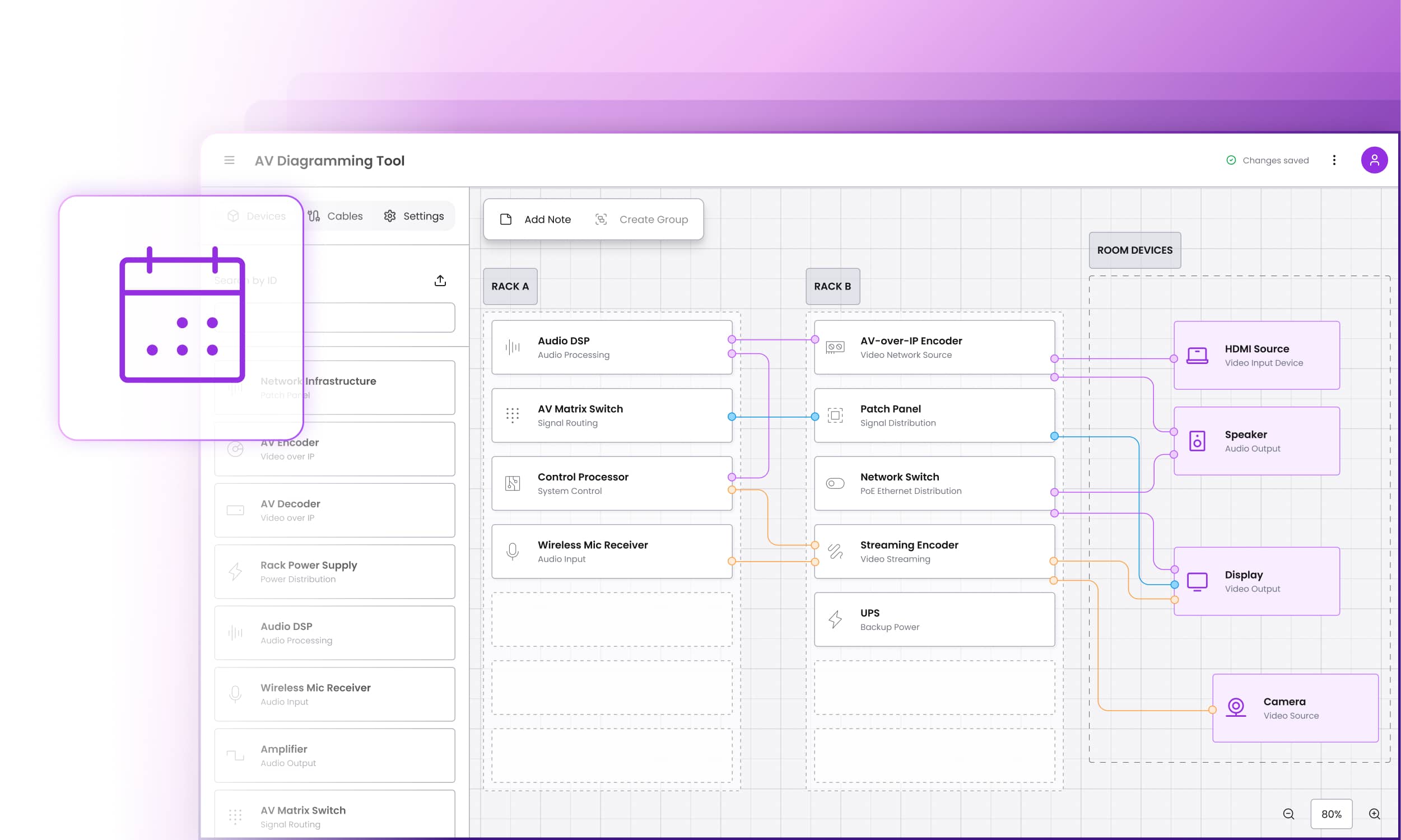
A custom-built AV system can act as a single source of truth for the whole company – from sales through engineering to installation. Instead of operating in disconnected tools, teams work inside one environment where product data, system logic, and documentation are unified.
This is not a theoretical concept. Custom-built solutions for AV companies already exist. They combine structured databases, validation rules, and visual generation layers into a single connected environment tailored to how a specific AV team operates.
For AV project management, the impact of custom software is significant:
- Everyone works on the same data set,
- Revisions are visible instantly across departments,
- Sales, engineering, and installers stay aligned,
- Collaboration happens simultaneously, not sequentially.
Choosing AV design software in 2026? Compare your options with the buyer's guide.
Download the guide
Sales teams – faster and safer quoting
In a custom-built system, sales teams can create simple quotes for a commercial AV system with drag-and-drop – but without the risk of technical mistakes. Instead of manually selecting components and hoping everything connects correctly, they configure solutions inside a structured environment that validates logic in real time.
Every adjustment made during negotiations updates the same underlying data model. If a device changes, the system verifies whether the rest of the configuration still makes sense. This makes quoting faster, but also safer. Sales can move quickly while staying within technically sound boundaries defined by engineering automation.
The result is a streamlined quoting process that remains error-resistant. Proposals, visuals, and system logic stay aligned from the beginning.
Engineers – less rework, more control
For engineers, this change is immediately practical. They no longer waste time rebuilding diagrams from spreadsheets or copying elements from other projects. The system already contains a structured, validated configuration prepared during sales.
Instead of starting from zero, engineers begin with an automatically generated baseline schematic. They can focus on optimizing system performance, refining logic, and solving real technical challenges – not redrawing connections.
When changes happen, updates flow through the platform automatically. There is no need to manually correct multiple files or track down outdated versions. This reduces repetitive work, lowers the risk of errors, and keeps engineering documentation consistent from presales to delivery.
Installers – clearer documentation on site
For installers, the biggest benefit is clarity and confidence on site. Instead of working from static PDFs that may already be outdated, they access the latest version of the system directly on a tablet or laptop. Every device, cable run, and connection reflects the current project state.
If a change was made during engineering, it is already visible. There is no confusion about which revision is correct. This reduces costly reworks and speeds up installation. Installers spend less time clarifying documentation and more time executing the project.
Business impact – how custom AV design software strengthens your entire company
Implementing custom AV system design software is not just a technical upgrade. It is an operational decision that affects how your entire company works, grows, and competes.
Team collaboration – one system, shared responsibility
When sales, engineers, and installers work inside the same environment, silos disappear. Everyone operates on the same structured data model. Changes made during quoting are visible to engineering. Updates introduced by engineers are reflected in documentation used on site. This alignment reduces miscommunication, eliminates duplicated effort, and ensures that the system delivered matches what was promised.
Engineering efficiency – freeing your most expensive resource
Engineering time is valuable. In fragmented workflows, engineers spend hours rebuilding diagrams, correcting inconsistencies, and synchronizing documentation. With engineering automation embedded in your AV design software, baseline schematics are generated from validated data. Engineers focus on system optimization and problem-solving instead of repetitive manual updates. This reduces operational waste and improves technical quality at the same time.
Leadership visibility – real-time insight into project status
A unified platform gives leadership a clear view of project progress, revisions, and workload distribution. Instead of chasing updates across departments, managers access real-time data. This improves forecasting, resource allocation, and strategic decision-making.
Client experience – professional documentation builds trust
Clients notice clarity. When proposals, diagrams, and final documentation are aligned and visually consistent, your company appears well organized and reliable. Custom software enables clean, validated outputs that are easy to understand and professionally presented. This strengthens trust and makes collaboration smoother throughout the project lifecycle.
Higher revenue potential – faster quoting and more projects
When sales teams can prepare technically validated quotes quickly, your company responds faster to opportunities. Faster quoting means you can handle more projects without increasing overhead at the same rate. At the same time, freeing engineers from repetitive work allows your organization to deliver more projects with the same core team.
Everything built around your workflow
Unlike off-the-shelf tools, a custom solution is designed around how your company actually operates. Your terminology, your approval logic, your documentation standards. The system feels familiar because it reflects your workflow. As your business evolves, the platform evolves with it – supporting long-term scalability without forcing disruptive process changes.
Synergy Codes – custom software built around your workflows
Synergy Codes specializes in building advanced, custom software for companies that need more than generic tools. We design and develop platforms that transform fragmented AV project management into connected, scalable systems.
Instead of forcing your team to adapt to generic software, we build systems that reflect how your company actually works. The result is greater operational control, faster delivery, and stronger positioning at the market.
Ready to connect your AV workflow?
Better AV project management starts with eliminating fragmentation. When quoting, engineering automation, technical drawing software, and engineering documentation management operate as one unified system, teams move faster and make fewer mistakes.
The result is simple: more projects delivered and stronger positioning in complex commercial AV system market environment.
If you are ready to replace disconnected tools with a platform built around your workflow, explore our custom AV design software.
- What is engineering automation?
Engineering automation means generating diagrams directly from structured data instead of drawing everything manually. When a device, cable, or configuration changes, the diagram can be easily updated with drag-and-drop. This reduces repetitive work, limits errors, and keeps documentation aligned across the entire project lifecycle.
- Can AI generate reliable AV diagrams?
AI can create diagrams that look technically correct, but it does not reliably validate signal flow, hardware constraints, or system dependencies. For complex AV systems, visual similarity is not enough. Engineering documentation must be logically consistent and fully traceable.
- How does a custom system improve quoting?
A custom platform allows sales teams to configure offerings in a structured environment that validates technical logic in real time. This reduces mistakes in proposals, speeds up quoting, and ensures that what is sold can be delivered without major engineering corrections.
- Does Synergy Codes build its own diagramming technology?
Yes. Synergy Codes builds custom diagram platforms and develops tools such as ngDiagram, designed for complex engineering workflows. This expertise allows us to create scalable, high-performance solutions tailored to AV companies with advanced documentation and automation needs.
Content Marketing Specialist who's spent the last decade making tech topics actually readable. With an MA in Brand Communication, Ida has crafted content strategies for several IT companies. Her portfolio spans from Kubernetes tutorials to enterprise software guides, now focusing on data visualization and diagramming solutions.

Find how we can help you enhance your software and win more deals
Contact us to discuss your project. After you submit the form, we’ll get in touch with you within 48 hours to arrange a call.