
Shaping the future of data visualization

Explore cutting-edge ideas, case studies, and expert perspectives on designing visual solutions and leveraging AI for smarter decision-making.

An abstract visual showing the dissolving purpure and lime gradient-colored element.
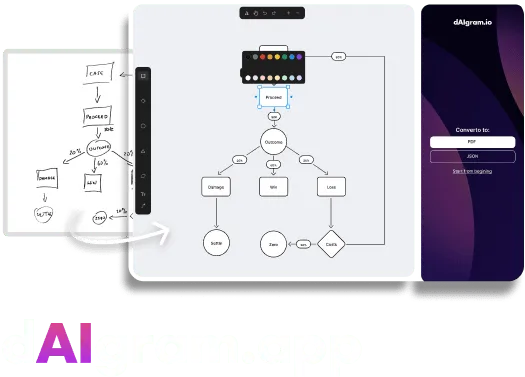
Hand-drawn flowchart transformed into a polished digital version.
Generate editable diagrams from pictures or screenshots

Convert any hand-drawn flowchart, whiteboard sketch, or screenshot of a diagram into a digital, editable format.

The artwork depicts an abstract design with large, curved shapes in gradient colors ranging from purple to yellow. The background is dark, and the shapes seem to overlap, creating a sense of depth and movement.
Featured
All articles

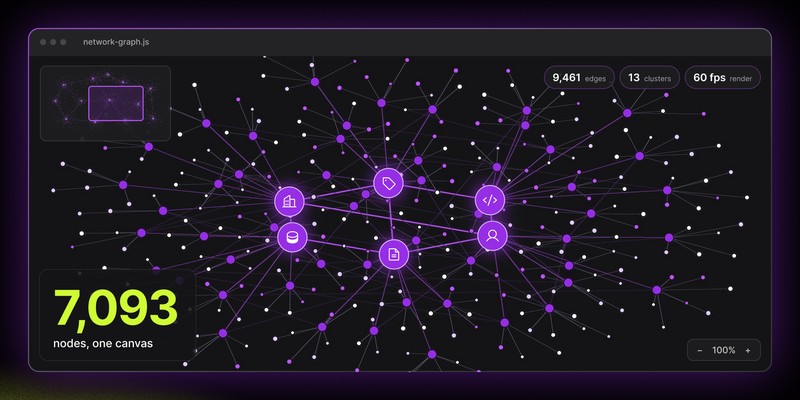
Large graph visualization in JavaScript: which libraries can handle thousands of nodes? 

A library that displays 20,000 lightweight points may still struggle with 2,000 complex nodes. Match the JavaScript graph library to your real workload. 

Ida Ożarowska
Nov 9, 2026

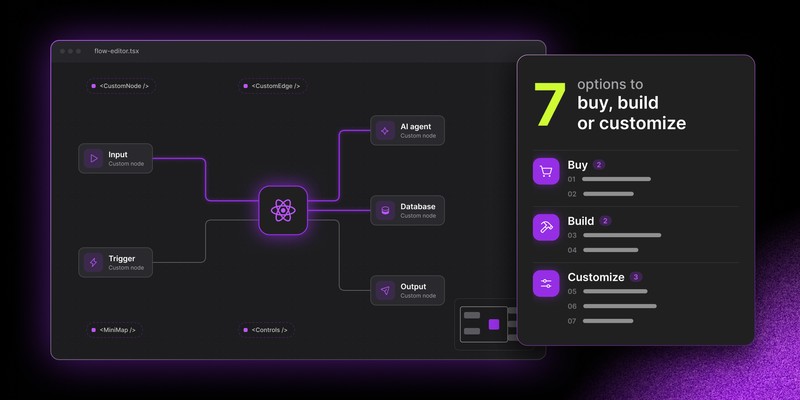
Production-ready React Flow components: 7 options 

React Flow gives you the canvas, but production editors also need toolbars, panels, layout, and keyboard UX. Here are 7 ways to fill that gap. 

Ida Ożarowska
Nov 8, 2026

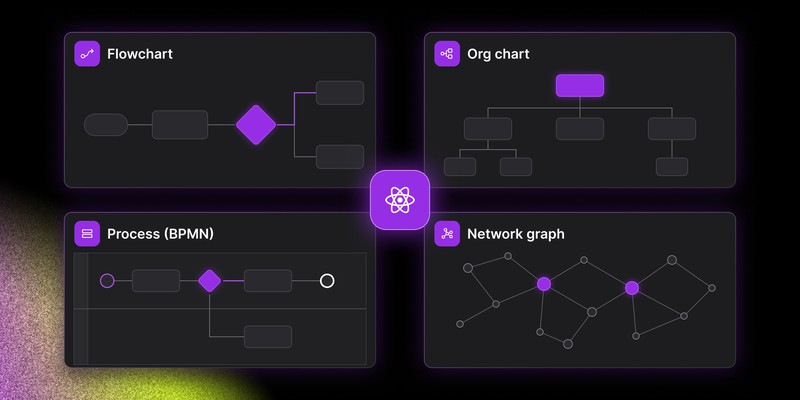
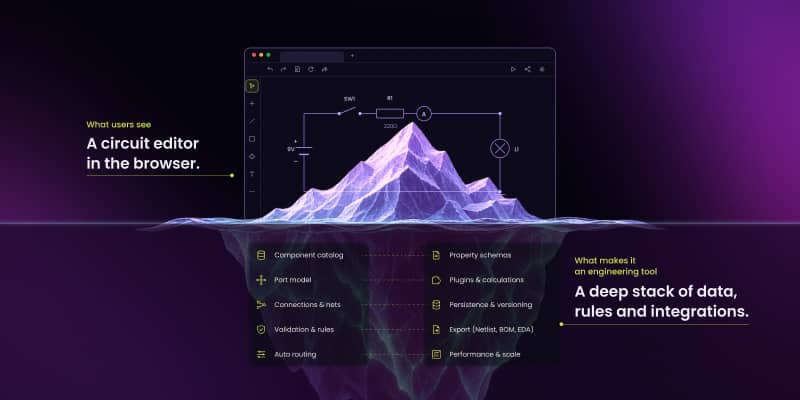
Best diagramming libraries for complex React applications 

Most React diagram libraries look alike in screenshots. The differences show up once your app needs real editing, larger diagrams, and collaboration. 

Ida Ożarowska
Nov 6, 2026

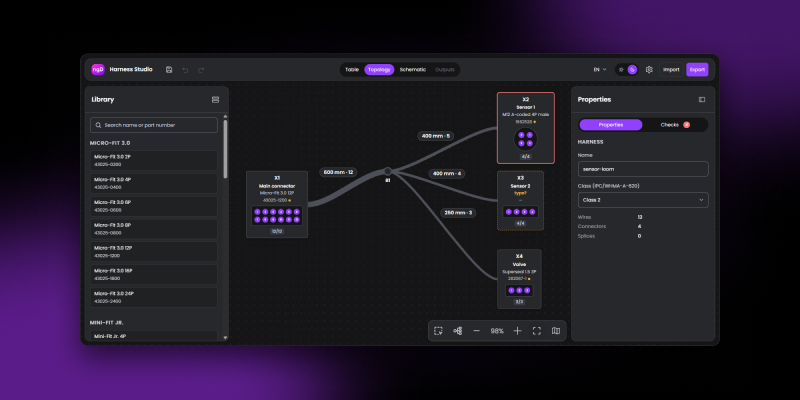
Custom wire harness design software: from Excel to editor

How we turned an Excel from-to list into browser-based wire harness design software in about 2 weeks, and why the domain took more work than the diagram.

Mateusz Jagodziński
Nov 4, 2026

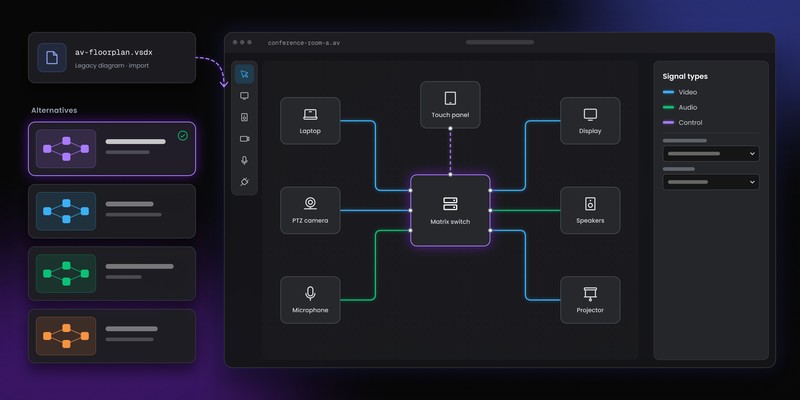
Best Visio alternatives for AV design teams in 2026

Visio handles basic AV diagrams but falls short once drawings must sync with equipment data, BOMs, and projects. See which of 7 alternatives fits your team.

Ida Ożarowska
Oct 8, 2026

Web-based schematic editor: the hard parts

A canvas with symbols is the easy part. Pin identity, first-class nets, junction rules and grid routing decide whether a schematic editor survives production.

Maciej Teska
Aug 23, 2026

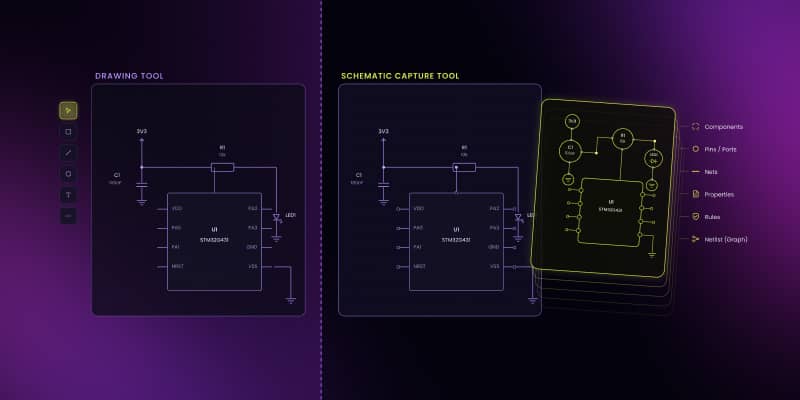
What is schematic capture (and why it's moving to the browser)

Schematic capture turns symbols and wires into a machine-readable circuit model. See what it contains and why concept-stage design is moving to the browser.

Maciej Teska
Aug 23, 2026

Large graph visualization in JavaScript: which libraries can handle thousands of nodes? 

A library that displays 20,000 lightweight points may still struggle with 2,000 complex nodes. Match the JavaScript graph library to your real workload. 

Ida Ożarowska
Nov 9, 2026

Production-ready React Flow components: 7 options 

React Flow gives you the canvas, but production editors also need toolbars, panels, layout, and keyboard UX. Here are 7 ways to fill that gap. 

Ida Ożarowska
Nov 8, 2026

Best diagramming libraries for complex React applications 

Most React diagram libraries look alike in screenshots. The differences show up once your app needs real editing, larger diagrams, and collaboration. 

Ida Ożarowska
Nov 6, 2026

Custom wire harness design software: from Excel to editor

How we turned an Excel from-to list into browser-based wire harness design software in about 2 weeks, and why the domain took more work than the diagram.

Mateusz Jagodziński
Nov 4, 2026

Best Visio alternatives for AV design teams in 2026

Visio handles basic AV diagrams but falls short once drawings must sync with equipment data, BOMs, and projects. See which of 7 alternatives fits your team.

Ida Ożarowska
Oct 8, 2026

Web-based schematic editor: the hard parts

A canvas with symbols is the easy part. Pin identity, first-class nets, junction rules and grid routing decide whether a schematic editor survives production.

Maciej Teska
Aug 23, 2026

Jointjs+ alternative: Performance comparison on the interactive diagram with thousands of objects using GoJS

See how GoJS outperforms JointJS+ in managing thousands of objects for interactive diagrams, offering better performance, data binding, and a user-friendly UI.

Content team
Jan 30, 2023

How to leverage charts and graphs in business

Learn how charts, graphs, and interactive diagrams simplify data, uncover trends, and improve decision-making, helping businesses leverage their data.

Content team
Sep 9, 2022

Do not make up your own requirements: A short story of our “howler”

Learn from our experience of a misaligned project where unclear client requirements led to challenges. Proactive communication and flexibility are key.

Piotr Błaszczyk
Aug 31, 2022

Vite - a worthy successor to Webpack? Pros and cons of both solutions

Compare Vite and Webpack in terms of speed, simplicity, and flexibility. Vite is ideal for fast development but may struggle with complex, legacy configurations

Kacper Cierzniewski
Aug 24, 2022

10 tips for better initial configuration of full-stack apps

Follow these tips for configuring full-stack apps, from using a monorepo with Nx to setting up code formatting and CI/CD pipelines, ensuring smooth development.

Tomasz Świstak
Aug 12, 2022

The Rust's Stories: Rust, ECS, and WebAssembly

Learn how Rust, ECS, and WebAssembly come together to create a turn-based roguelike game, with challenges, solutions, and valuable lessons for game developers.

Content team
Aug 1, 2022