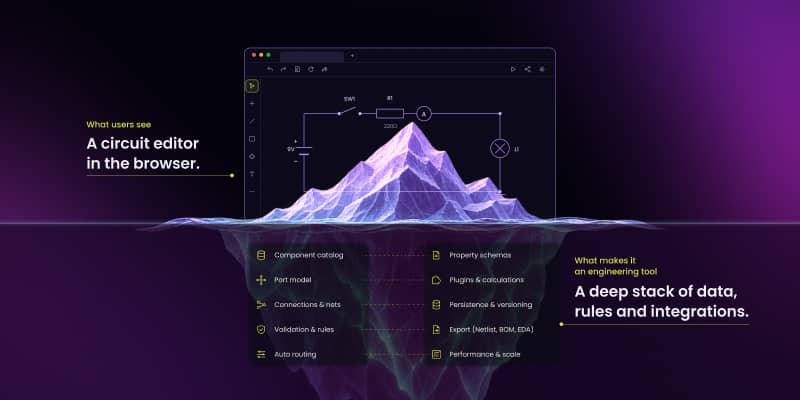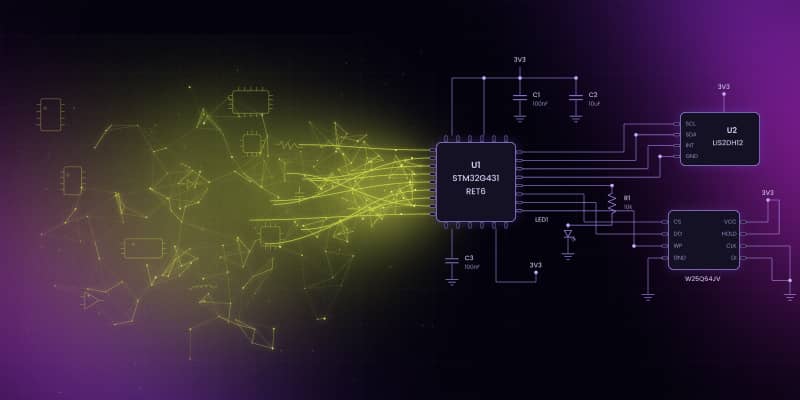

A canvas with symbols is the easy part. Pin identity, first-class nets, junction rules and grid routing decide whether a schematic editor survives production.
What is schematic capture (and why it's moving to the browser)
Schematic capture turns symbols and wires into a machine-readable circuit model. See what it contains and why concept-stage design is moving to the browser.
A canvas with symbols is the easy part. Pin identity, first-class nets, junction rules and grid routing decide whether a schematic editor survives production.
What is schematic capture (and why it's moving to the browser)
Schematic capture turns symbols and wires into a machine-readable circuit model. See what it contains and why concept-stage design is moving to the browser.
The importance of adaptability in R&D: A devdebate
Dynamic and adaptable nature of the R&D team at Synergy Codes, where team members thrive on variety, tackling diverse tasks across multiple technologies.
Jointjs+ alternative: Performance comparison on the interactive diagram with thousands of objects using GoJS
See how GoJS outperforms JointJS+ in managing thousands of objects for interactive diagrams, offering better performance, data binding, and a user-friendly UI.
Do not make up your own requirements: A short story of our “howler”
Learn from our experience of a misaligned project where unclear client requirements led to challenges. Proactive communication and flexibility are key.
Vite - a worthy successor to Webpack? Pros and cons of both solutions
Compare Vite and Webpack in terms of speed, simplicity, and flexibility. Vite is ideal for fast development but may struggle with complex, legacy configurations
10 tips for better initial configuration of full-stack apps
Follow these tips for configuring full-stack apps, from using a monorepo with Nx to setting up code formatting and CI/CD pipelines, ensuring smooth development.